How Hybrid Vector and Graph Retrieval Works for Enterprise Q&A
Different questions need different retrieval methods to find the right evidence.
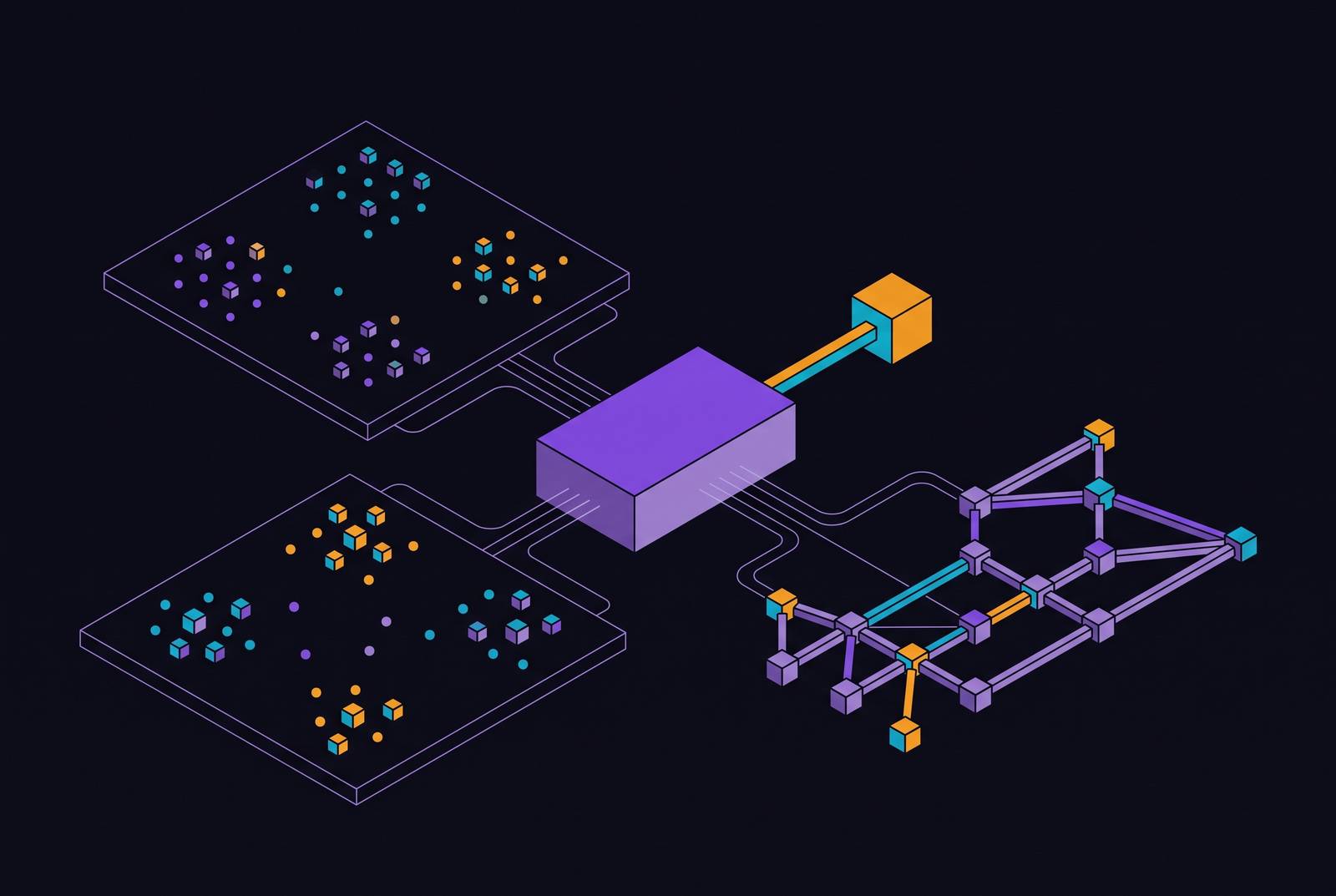
Hybrid vector and graph retrieval works for enterprise question answering because different questions need different kinds of evidence. Matching the retrieval method to the question is what produces a usable answer.
Why one retrieval method cannot handle all the questions enterprise users ask
A technical support query includes an exact error string. But the system returns passages about the general problem and misses that error. A contract question asks who approved a change and which clause they modified. The system retrieves separate chunks without the link between them. The failure is a mismatch between what the question needs and what the retrieval method can represent.
Enterprise users move between very different demands without saying so. A conceptual question needs language matching that finds the same idea even in different words. A point lookup needs the right identifier. A relational question needs a chain of evidence. A system built around only one of these will have blind spots in the others.
Microsoft's TREX research separates fact-based queries from thematic queries that need information pulled together across many documents. That distinction matters because finding a single fact and assembling an explanation are different jobs. HVM-GraphRAG (2026) identifies financial report analysis, legal document understanding, technical support, and scientific literature retrieval as settings where isolated chunks of text are not enough. The system must account for their differences before the language model receives its evidence.
What vector search does well and where it falls short
Vector search converts text into numbers called embeddings. These numbers capture meaning. The system can retrieve documents about "cars" for a query containing "automobile" because the words have similar meanings. That flexibility helps when users do not know the vocabulary in the source material.
Sparse retrieval, such as BM25 and TF-IDF, works differently. Instead of meaning, it scores exact word overlap. This makes it fast and precise on exact terms. It also works across topics without needing to be retrained. But literal matching breaks when a query says "bicycle repair" and the source says "fixing a bike". Dense, meaning-based search bridges that vocabulary gap. Sparse, word-overlap search keeps distinctions that meaning-based similarity can blur.
Those distinctions matter for product codes, error strings, statute clause numbers, and identifiers. Standard embeddings handle such terms poorly. They are underrepresented in training data and lack useful neighbours. Late-interaction models such as ColBERT, which match at the level of individual words rather than whole passages, help with this. But they need much more computing power. Changing the embedding model also means reprocessing the entire index from scratch.
The deeper limit is representational. Embeddings capture topical closeness. They leave typed relationships unrepresented — such as who is the counterparty in a contract, or how records across separate datasets connect. HVM-GraphRAG (2026) identifies a related loss when flat retrieval separates chunks from document hierarchy, tables, section relationships, and figure-caption links. A passage can be close to the question in meaning without preserving the structure needed to answer it. Similarity does not supply the missing relationship.
What graph retrieval adds and where it breaks down on its own
Graph retrieval makes relationships explicit. It uses labelled connections called typed edges to show how entities link together. The system can follow a path as well as rank nearby text. HyGRL (2026) describes these structured reasoning paths as a core difference from vector chunk retrieval. They support questions about who approved a contract and what clause that person modified. The connection between the facts becomes part of the evidence.
That structure also supports organisational hierarchy traversal, policy boundary enforcement, and provenance tracing — following a chain back to where the evidence originally came from. These tasks depend on the kind of relationship between records. Graph retrieval can follow that chain when the relevant links exist.
HyGRL (2026) describes how language models use many processing steps and lose information when they extract complex relations from text into graphs. HVM-GraphRAG (2026) identifies expensive traversal as another constraint, particularly in dense graphs with many entities. Its findings also show that graph-based methods do not consistently beat flat retrieval on complex document questions without careful architecture. More structure is not automatically better retrieval.
Most importantly, a graph can only follow the relationships available to it. HyGRL (2026) reports that even large, densely maintained knowledge graphs leave only 37.6% of query-answer pairs reachable within three hops. A missing relationship interrupts the reasoning path even when useful evidence exists elsewhere. This is structural sparsity, and it is the main limit of graph-only retrieval. A well-defined path is no help if it stops short of the answer.
How hybrid retrieval combines the two methods to cover the full range of questions
The simplest hybrid pipeline combines dense, meaning-based vector search with sparse, word-overlap BM25 search. Both passes run at the same time. Reciprocal Rank Fusion (RRF) — a method that merges ranked lists by position rather than score — then combines their results. The top results go into the language model's context. RRF works from rank positions, so scores from different methods do not need to share a scale. The result keeps both conceptual matches and exact-term matches.
That is search fusion, but it does not solve every relational question. Joining two lists at the end cannot bring back bridging evidence that neither search found. Multi-hop questions — ones that need to connect several facts across records — need structured relationships and unstructured text to work together during retrieval. HyGRL (2026) addresses this through a network that embeds unstructured text into a structured knowledge graph.
Other designs make different choices about how to connect these capabilities. HMGI (2025) combines approximate nearest neighbour search — finding close matches quickly in a large index — with expressive graph traversal in one system. It uses modality-aware partitioning to shape the index for each data type. HVM-GraphRAG (2026) instead searches a small concept-level graph. It uses a concept-to-chunk index built offline to reach the multimodal evidence that supports it. This keeps the relational structure without the cost of traversal through a dense entity-level graph. KG²RAG (NAACL 2025) focuses on fact-level relationships between chunks. It improves the variety and coherence of evidence for multi-entity questions.
Basic fusion combines independent rankings. Graph-text retrieval connects evidence across a reasoning path. Microsoft's TREX research shows that combining graph-based and vector-based retrieval can outperform conventional vector-based retrieval when pulling together mixed sources. Designing the architecture means choosing which methods to include. It also means deciding where those methods must work together to supply the evidence the query needs.
Matching the retrieval design to the shape of the questions and the system
Query topology means the shape of the evidence needed to answer a question. A semantic question may need a passage that answers it even if the wording differs. An exact-match question may depend on one identifier. A multi-hop question needs facts that link entities, with text evidence found along the path. These shapes should determine your retrieval setup.
Before you build, check a sample of real queries. See which of those three demands they have. Find out what share needs exact-term matching, what share needs multi-hop entity traversal, and what share is semantic or conceptual only. For relational questions, identify the records and systems the answer must cross. That analysis gives the design a solid basis for weighting retrieval paths. It also shows whether simple RRF fusion is enough or whether the workflow needs a unified graph-text reasoning space.
When semantic and exact-match questions dominate and relational questions are rare, vector search plus sparse retrieval and RRF can be enough. Most enterprise knowledge base queries fall into this group. A graph adds little to a conceptual question unless the answer needs cross-document synthesis. But compliance chains, organisational hierarchies, and multi-party contracts can need traversal that follows links explicitly. In those workflows, missing graph links and isolated text chunks are linked problems.
Insurance agent licensing makes the distinction concrete. State licensing requirements and records of exam completion are structured. Correspondence with candidates and their educational transcripts are unstructured. Answering a question about a specific candidate can need evidence from all of them. A context graph connects what those records mean for the same person. Vector retrieval finds relevant unstructured material. The design follows the workflow's evidence path.
Where hybrid retrieval breaks without good data quality and access control
Matching the architecture to the questions is necessary. But it cannot fix poor inputs. Missing ownership context, certification status, lineage, and governed business vocabulary weakens what both retrieval paths can use. Dense search embeds text without that context. Graph retrieval relies on relationships whose meaning may be unclear. Adding governed metadata before embedding improves retrieval accuracy.
The graph needs the same care when new material is added. HVM-GraphRAG (2026) finds noisy or conflicting updates when concepts extracted locally are added without a view of the whole document. Its "holistic view" construction principle checks new extractions against the wider document state before insertion. Meanwhile, HMGI (2025) identifies a consistency risk when vector and graph indexes are maintained separately during dynamic ingestion. Keeping those indexes in sync requires adaptive, low-overhead updates.
Permissions are another upstream condition, and storage controls alone are not enough. Retrieval that crosses silos must enforce access at query time. It cannot surface records the requester is not authorised to see. Attribute-Based Access Control (ABAC) — a standard that grants access based on user attributes, document sensitivity, and query context — supports dynamic policies. Document-level permissions must carry through retrieval. The top results should already be filtered before reaching the language model. Otherwise, a retrieval-layer mistake can become a confidentiality failure in the answer.
The same layer must make its evidence inspectable. An audit needs to show which passages grounded a recommendation. It also needs to show whether they came through the vector path or the graph path. Without that record, there is no reliable basis for investigating an error or a disputed output. Retrieval must log what it found and why. This trace is the bridge from a working search architecture to an accountable enterprise system.
What enterprise deployment of hybrid retrieval requires in practice
Deployment begins with a data layer that places structured records and unstructured content in a unified, permission-governed context. The context graph gives items retrieved from existing systems of record a shared business meaning that links them together. Start with one named workflow, one accountable owner, and a measurable outcome. That scope makes the query mix, relevant sources, and baseline explicit. It gives the hybrid design a specific job whose results you can evaluate.
Begin with read access and investigation before you grant execution permissions. You can then assess retrieval and recommendation separately from any system-of-action layer. Decision records should connect the retrieved passages and their retrieval paths to the reasoning, any human judgment or approval, and the final recommendation or action. This keeps the chain from evidence to outcome intact. It also makes clear where a disputed decision depended on retrieval and where it depended on judgment.
The architecture should work with any embedding or language model at both the retrieval and generation layers. Embedding models and graph construction models will change. But the enterprise context graph, governed vocabulary, and decision history should not need rebuilding with them. With that separation, indexes still need maintenance specific to each model. It keeps the durable business context distinct from the models used to search and interpret it. VPC, on-premises, or cloud deployment should follow data sensitivity and regulatory obligations, with access scoped to the underlying records.
Finally, monitoring must include the ability to pause or remove a retrieval path that produces consistently wrong or out-of-scope results. You need to be able to inspect, correct, and restrict it without rebuilding the whole system. Hybrid retrieval succeeds when it connects the evidence a workflow needs, respects who may see that evidence, and preserves how the answer was reached. The test is a usable, authorised, traceable answer.