Data Quality Monitoring Rules for Enterprise Graph Nodes
Stale ownership records and conflicting data across systems silently corrupt AI agent decisions.
An AI agent approves a license renewal based on an ownership record that hasn't been checked in months. The owner left the role, the policy tag is out of date, and nobody flagged either one before the agent acted. That's the failure this article is about: enterprise graph nodes carrying stale ownership records, broken entity links, and conflicting values across silos, corrupting the context AI agents depend on before any action gets taken. None of this produces an error message: the agent doesn't know the node is wrong, so it acts anyway, and the mistake only becomes visible after the decision is made.
Gartner found that most AI projects get abandoned when they lack AI-ready context infrastructure, and this is that pattern. These projects fail because the context graph nodes those models query are incomplete, inconsistent, or out of date. And the failure compounds across silos. A person's application might sit in one system, their licensing status in another, and their support history in a third. If the nodes representing those records carry stale or conflicting values, an agent acting on that person's case is working from a false picture of their situation, and it has no way of knowing that.
Most organizations still clean up data quality periodically, but they don't watch it continuously at the node level. That approach worked reasonably well when humans were the ones reading dashboards, because a person could pause, question a weird number, and go check. Agents don't pause. Monitoring has to live inside the data catalog and the governance framework itself, so that trust signals travel with every node at the moment an agent queries it, not after.
The four node-level properties that monitoring rules must cover
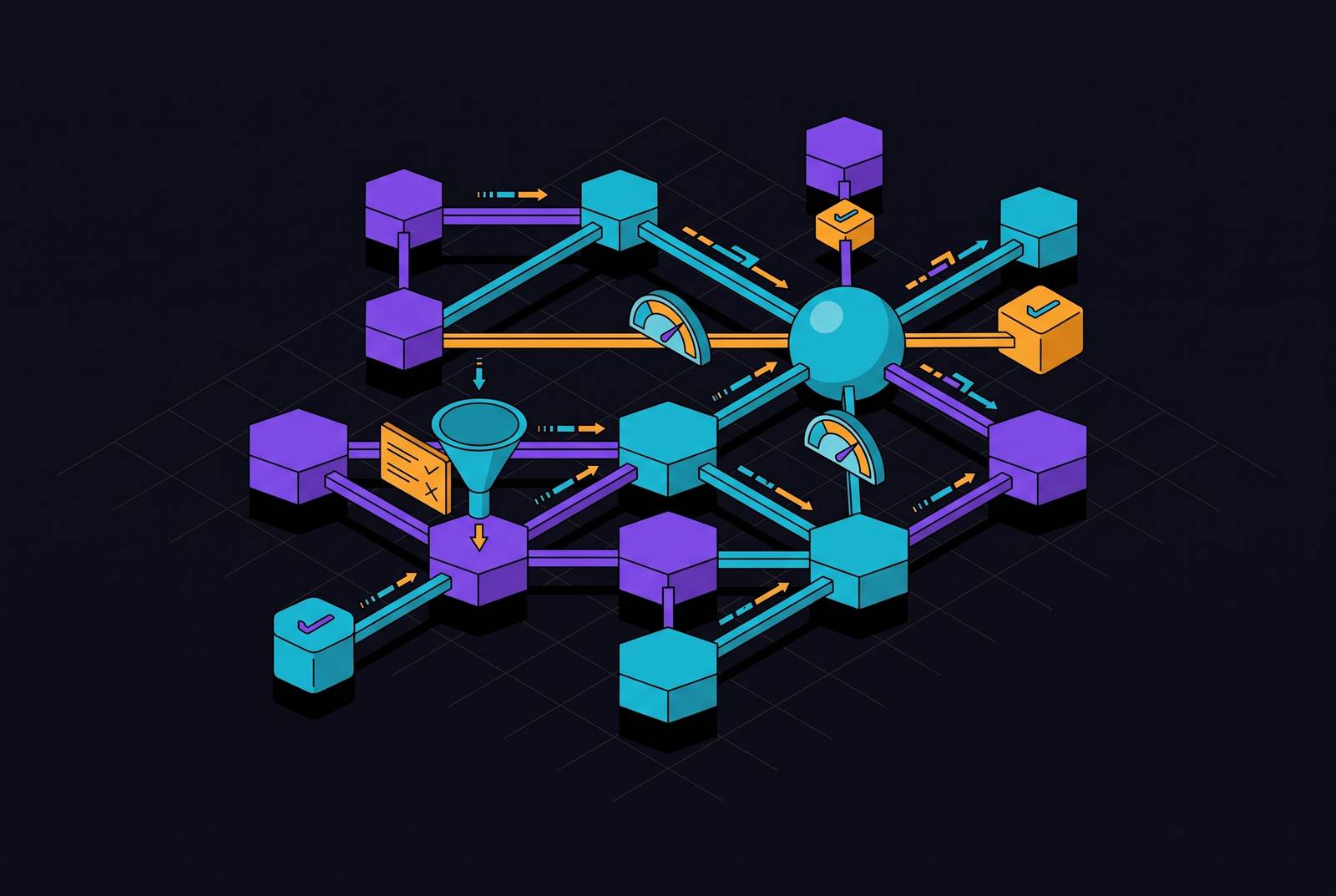
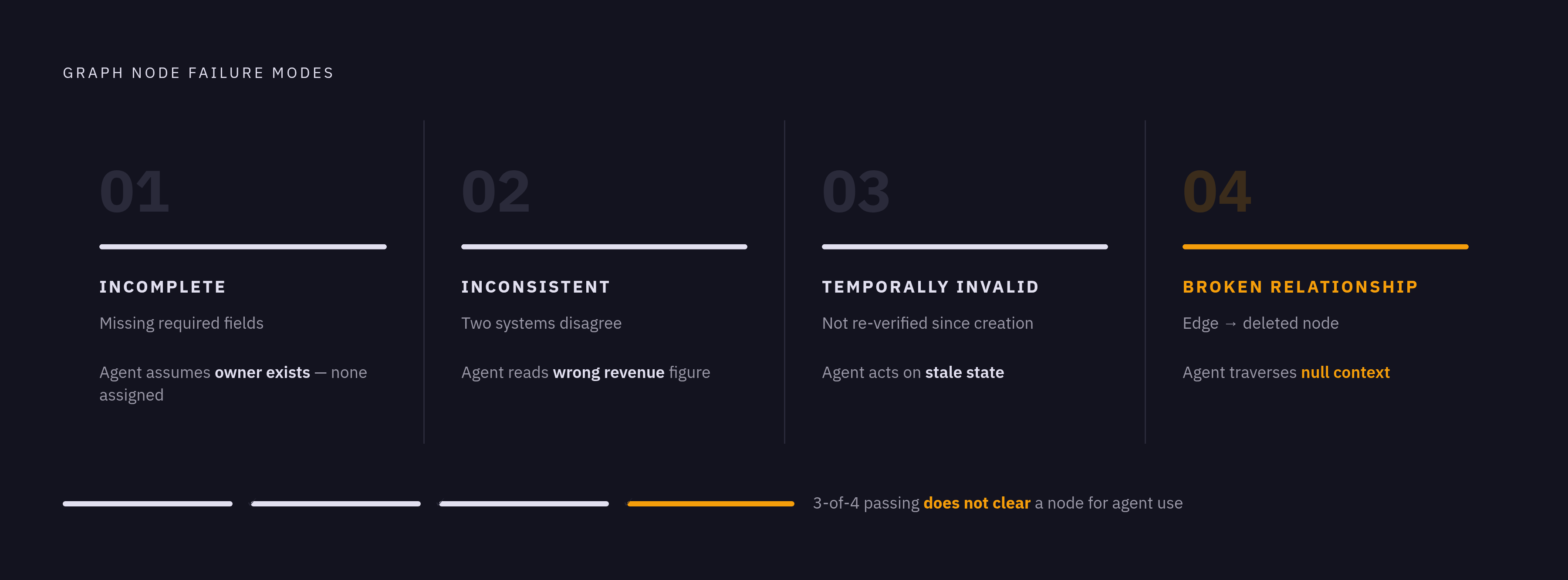
Monitoring rules for enterprise graph nodes need to cover four distinct properties, because if just one fails, an agent's context can be corrupted even when the other three look fine. Think of these as four separate ways a node can quietly go bad, each requiring its own check.
A node can be incomplete: it's missing a required field, like an owner assignment, so when something goes wrong there's no one to route the alert to. A node can be inconsistent: two systems both claim to hold the canonical value for the same thing, like revenue, and they disagree. A node can be temporally invalid: the information was correct at some point but hasn't been re-verified since, and the agent has no way to tell old from current. And a node can have broken relationship integrity: it links to another node that no longer exists or has been reclassified, so the edge itself is lying.
These four properties interact rather than operate in isolation. A node can be complete and perfectly fresh, yet it can still contradict its peer nodes. A node can be internally consistent and well-connected, but its ownership record can still have expired months ago. That's why monitoring rules have to run across all four properties at the same time, as simultaneous checks where passing one does not clear the node for use.
Completeness rules: what a node must declare before an agent can use it
If a node is missing required attributes, that's not a minor gap, it means nobody is accountable for it. If a node has no owner, no domain classification, and no policy tag, nobody can catch a bad result before an agent acts on it.
Start with ownership. A named owner is a specific person or role who can actually receive an alert and make a call. Without that, an alert has nowhere real to land, and an exception has no one assigned to resolve it. Domain classification matters for a related reason: it routes quality alerts to the right steward and lets access controls apply correctly based on business function. A policy tag marks which regulatory obligations apply to a node, like data residency or consent requirements, and these change as laws and jurisdictions shift; you can find more on this in the temporal validity rules further down.
Two more attributes round out a minimum viable node specification. A source system reference lets an agent trace a value back to where it actually came from. Without that trail, there's no way to audit the node when a result looks wrong. And a last-verified timestamp records when a human or an automated process last confirmed the node's attributes still hold up; that's not the same as when the source system last changed the underlying data.
Getting there requires ongoing profiling, not a one-time setup. If teams keep scanning datasets continuously for unexpected shifts in structure or completeness, they can catch nodes that were fine at ingestion but quietly degraded as upstream systems changed shape. Platforms built around a graph structure can embed stewardship directly into each node rather than relying on a spreadsheet maintained somewhere else, so when a completeness rule fires, the alert routes automatically to the right owner based on relationships the graph already models.
Some teams push back here, arguing that requiring every attribute before a node becomes queryable slows ingestion down. That tradeoff misses what happens to the node otherwise. An incomplete node doesn't disappear from the graph just because nobody filled in the missing fields. It sits there as a liability that stays invisible right up until an agent acts on it and the action goes wrong.
Consistency rules: resolving conflicting values across silos before they reach an agent
Conflicting values are more dangerous than missing ones, because a node can carry a wrong value and still pass every completeness check. It looks fine. It just isn't true, and two different nodes can each look individually valid while they flatly contradict each other.
The clearest version of this problem: an agent interprets "revenue" using a BI dashboard's definition when that number conflicts with the finance team's canonical source. The agent doesn't hesitate or flag uncertainty. It gives a confident answer that happens to be wrong, and the root cause isn't a weak model, it's business context that was missing or in conflict before the agent ever queried it.
Consistency rules need to work at three separate levels. Semantic consistency means the same business term has to resolve to the same definition everywhere it appears in the graph. Atlan's enterprise data graph handles this with a business glossary that ties AI-generated term links into the graph itself, so agents querying the same term from different tools land on a consistent meaning. Value consistency means that when two nodes describe the same real-world entity, a customer, a policy, a product, their overlapping fields can't contradict each other. Logical checks, like confirming a delivery date falls after its order date, or that a customer's listed age matches their birth year, catch this kind of error at the table level. Schema consistency covers what happens as upstream systems change shape over time: column renames, type changes, fields quietly deprecated. Static rules go stale the moment the schema underneath them shifts, so automated drift detection has to catch these changes as they happen.
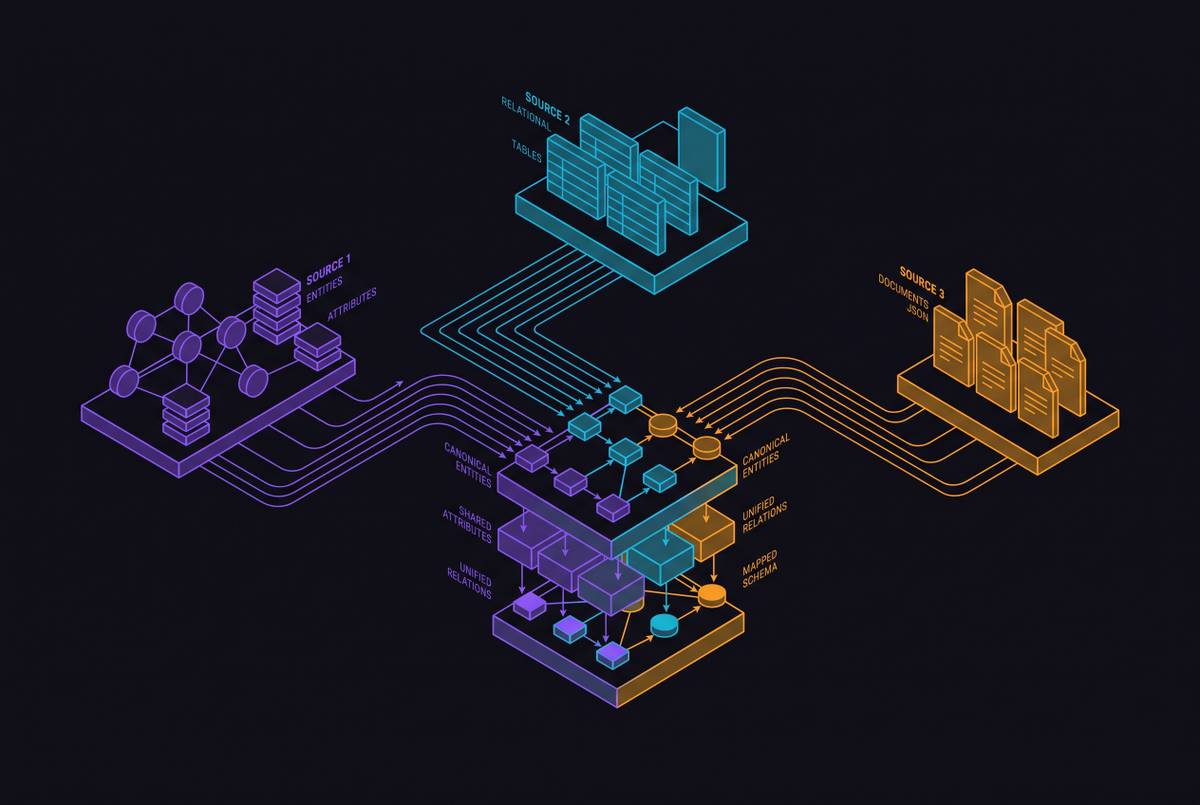
The finance-versus-dashboard mismatch is a governance problem that organizations resolve through policy and process, not a technical one. Plenty of organizations resolve "which number is right" through a recurring meeting between finance and BI. Agents don't attend those meetings, so the resolution has to be built into the graph before anything gets deployed, not worked out after an agent has already acted on the wrong number. Nodes Engine, the context graph product behind this publication, applies that principle directly: it connects a person's application, licensing progress, and support history, which might sit in three separate systems, at the level of meaning rather than just as separate records, so an agent working that person's case queries one consistent view.
Temporal validity rules: expiring stale nodes before agents act on outdated context
A node that was accurate the day it was created can turn into a liability six months later if nothing defines when it needs to be checked again. The longer an agent fleet keeps running against a graph, the more of these stale nodes pile up quietly, undetected, in the layer agents are actually querying.
Ownership records make the risk clearest. Steward assignments should carry a maximum validity window tied to how often the organization's roles actually change, typically yearly reviews or whenever someone changes position. An owner who left the company six months ago cannot field an exception, answer a question, or make a judgment call, and a node still listing that person as the responsible party has no real accountability behind it at all. This is a governance gap before it's anything else: the node points to someone who isn't there to catch the problem.
Policy tags carry a related but narrower risk. Regulatory classifications shift as laws change and as data moves across jurisdictions, so a GDPR tag applied two years ago may no longer match current rules on data residency or processing consent.
What makes this urgent specifically for agents, rather than for human analysts, comes down to how each one operates. If a human analyst notices an owner's name doesn't match anyone currently on the team, they will pause and ask a question. An AI agent querying the graph at machine speed has no built-in reason to doubt a node's staleness, and it will treat an outdated owner assignment as current fact unless a temporal rule catches it first. That gap between human skepticism and machine literalism is what makes node-level expiry rules necessary rather than optional.
If you put this into practice, you assign a default re-verification interval to each node type when you design the graph, surface nodes approaching that expiry on a stewardship dashboard where a human can see them coming, and block agent read access to any node past its validity window until someone confirms or updates it.
Relationship integrity rules: validating edges before broken links corrupt agent reasoning
A graph node is only as useful as the edges connecting it to everything else, and a node whose relationships point to something deleted, reclassified, or renamed will produce a reasoning error that neither the node nor its broken target will show on its own. The node still looks complete. The edge is just lying about where it leads.
Orphaned edges are the most common version of this. A relationship points to a node that's been deleted or retired, and this happens constantly after system migrations, schema retirements, or two entities getting merged into one. The source node still looks complete and valid when it sits on its own. Traverse its edge, though, and the agent gets nothing back, or gets routed to the wrong target entirely, with no indication anything went wrong along the way.
Reclassified targets create a quieter version of the same problem. A node links to a dataset that was marked "public" when the edge was created, and that dataset later gets reclassified as "restricted." The edge itself never changes, so it keeps implicitly granting access to context that the linking node's owner may no longer have the authority to reach. The edge's structure carries no flag indicating that the permissions underneath it have shifted.
Cardinality violations round out the picture. A relationship meant to be one-to-one, say, one canonical owner per dataset, can silently become one-to-many after a system migration creates duplicate entries. An agent asking a simple question like "who owns this?" gets back multiple conflicting answers, with no timestamp or lineage marker in the graph indicating which record is current.
These failures matter beyond the immediate wrong answer, because they also break the audit trail. Lineage, policy tags, and timestamps built into the graph are supposed to let an organization prove exactly which data and which policies drove any given AI answer, but that proof only holds if every edge connecting those nodes is valid. A broken lineage edge means the audit trail stops short of the source of record, right at the point where someone needs it most. Catching this class of failure takes a different kind of check than column-level monitoring: traversal queries that walk the graph specifically looking for dangling references, cardinality anomalies, and mismatched classifications, rather than checks that only ever look at one node at a time.