Schema Mapping and Canonical Data Model Design for Multi-Source Graphs
Agentic AI makes wrong entity mappings catastrophic, not just bad dashboards.
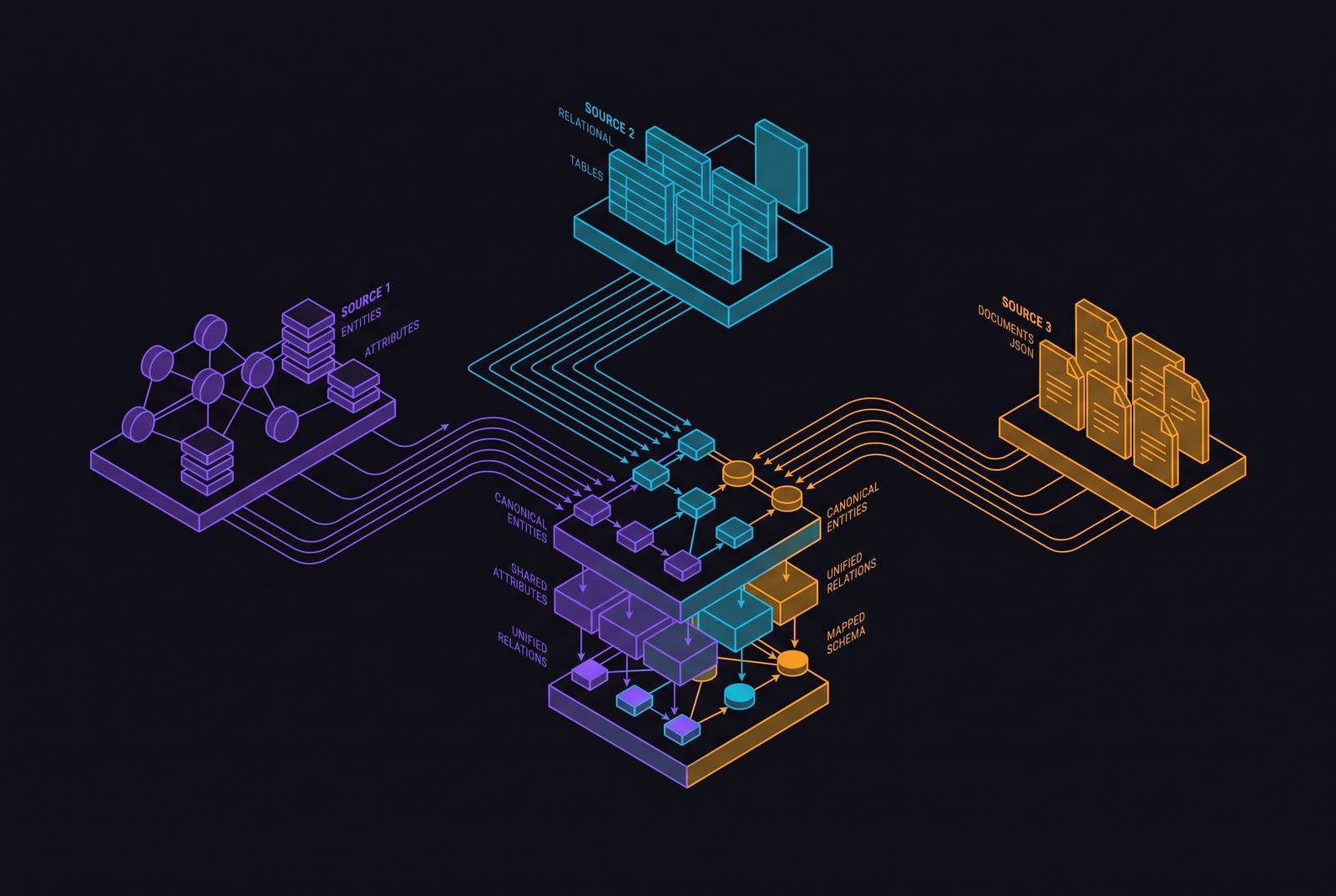
Most enterprises run separate systems for applications, licensing, support history, payments, and claims. Data about the same person or the same policy sits in every one of those systems, but the relationships between those records don't exist anywhere. Nobody wrote them down. That's the practical gap most integration projects run into: pulling data into one place is a storage problem, and it's the easy part.
Reasoning across those sources is a different kind of problem. It's semantic, not mechanical. A graph that just holds records from six systems side by side hasn't solved anything; it's just moved the mess. Reasoning across silos requires a shared model of entity definitions ("customer", "event", "policy") that hold their meaning regardless of which system contributed the record.
Skip that step, and the cost doesn't stay flat, it compounds. Add a canonical model to the same six applications, and that number drops to 12. That ratio reflects a compounding cost, not a rounding error. It's what happens when every system has to negotiate its own private dialect with every other system, instead of everyone agreeing on one common language up front.
None of this was optional before, but it's become urgent now for a specific reason: agentic AI systems don't just report on data anymore, they act on it. A wrong or ambiguous entity mapping used to produce a bad chart on somebody's dashboard. Now it produces a bad autonomous action, one that might approve the wrong claim or route a request to the wrong person before anyone notices. That's the stakes shift this piece is built around.
The canonical data model is the structural decision that produces this outcome. Design it well, and a multi-source graph can actually reason across silos. Design it poorly, or skip it, and the graph just accumulates data without ever resolving what any of it means.
What a canonical data model does in a multi-source graph
A canonical data model, at its core, is a design pattern for translating between different data formats. It's application-agnostic by construction: every system talks to the canonical format instead of negotiating its own translation with every other system it touches.
The architectural payoff appears the moment something changes. If one source system's internal format gets updated, only the transform between that system and the canonical model needs to change. Every other system downstream keeps working exactly as it did. That's the whole point of the pattern: isolate change instead of letting it ripple outward.
Inside a graph, the canonical model produces shared entity definitions, things like "customer," "event," or "policy," that keep their meaning no matter which source system contributed the underlying record. A customer is a customer whether the record came from the billing system or the support desk. That consistency is what lets metadata management, data lineage tracing, and compliance auditing actually function, and it's also what makes AI model training on that data reliable instead of noisy.
The canonical model is the shared schema itself, and the canonical transform is the specific mapping logic that converts a source system's format into that schema, or back out of it. The model is the shared schema itself. The transform is the specific mapping logic that converts a source system's format into that schema, or back out of it. One is the blueprint, the other is the implementation. Confuse them, and teams end up rebuilding the whole model every time a single source system changes, which defeats the purpose.
Mapping also isn't always a clean one-to-one affair. A single source object, say an "Account Id" nested under "Sales Order," might need to map to multiple entity groupings in the canonical schema at once. A model that can't handle that kind of one-to-many relationship breaks the moment real enterprise data hits it.
Equally important is what a canonical data model is not. It isn't a data warehouse schema. It isn't a single unified database. It isn't a golden master record that replaces the source systems, but a shared vocabulary and translation layer. It's a shared vocabulary and a translation layer, full stop. The source systems stay exactly where they are.
The three classes of conflict that schema mapping must resolve before a graph can be built
Bosch's constraint-guided mapping research, published by Monka and colleagues on arXiv in August 2026, sorts enterprise schema heterogeneity into three distinct classes. Treating them as one problem is where most mapping projects go wrong.
The first is representation. A single source field sometimes encodes two things at once, implicitly. Think of a field that bundles engine displacement and a year range together in one string, when the canonical target expects those split into separate attributes.
The second is structure, and this one trips up naive matching approaches constantly. A source field might say "engine cc=1000," while the target expects "engine size=1.0 L". Those two strings share no characters in common, no lexical overlap at all, yet they describe the exact same fact. Any matching approach that leans on string similarity is dead on arrival here.
The third is semantics: abbreviations, multilingual variants, naming conventions that drift as schemas evolve across vendors and over years.
These three classes need different tools, and treating them as one similarity score is the root cause of most mapping failures. Representation and structure determine what qualifies as an admissible candidate match. Semantics only gets resolved once you're already inside that admissible set. Skip straight to semantic similarity without first filtering on structure, and you'll get fluent-sounding matches that are quietly wrong.
Flores and colleagues, writing in the Semantic Web journal in 2024, add a complication that never goes away: sources aren't static. Schemas drift, vendors update their formats, new fields appear. That reality rules out the one-time waterfall mapping project. What it calls for instead is a pay-as-you-go approach, one built for incremental integration as new sources appear.
Getting those two records to match requires the graph to assert that they refer to the same real-world entity. String matching gets nowhere near it Constraint-Guided Enterprise Data Mapping with Large Language Models.
The lesson for anyone designing the graph itself: a canonical model that doesn't explicitly encode unit expectations, aggregation levels, and field decomposition rules won't resolve conflicts like this. It'll just store them, sitting there under a unified-looking label, waiting to cause a problem later.
How schema mapping methods have evolved into constraint-guided approaches
The legacy stage was ontology-driven: predefined domain ontologies dictated the mappings up front. That worked fine until it met a domain nobody had anticipated at design time, and then it broke, because the whole approach assumed the vocabulary was known in advance.
The data-driven stage moved past that assumption. LKD-KGC, from Sun and colleagues in 2025, introduced adaptive embedding-based schema integration, extracting entity types and merging them through vector clustering and LLM-based deduplication. Alignment started emerging from the data itself rather than from a rulebook someone wrote months before seeing the actual sources.
Then came LLM-enabled canonicalization. EDC, short for Extract, Define, Canonicalize, from Zhang and Soh in 2024, has language models generate plain-language definitions of schema components and then compares those definitions using vector similarity.
But pure LLM matching has a failure mode that occurs repeatedly: it improves semantic recall while quietly violating structural and physical constraints, producing correspondences that read fluently but don't actually hold up operationally.
That's the gap constraint-guided mapping, or CGM, was built to close. It's a neuro-symbolic method: symbolic constraints act as operators on the hypothesis space before neural reasoning ever runs, rather than showing up afterward as a validation pass. The order matters enormously.
The method also turns out to be model-independent. The constraints are doing the heavy lifting, not the size of the model behind them. Across seven different enterprise makes, each governed by its own automatically discovered and expert-refinable constraints, the approach holds a macro F1 of 0.70, and it cuts the expert effort required compared to spreadsheet-based workflows by roughly a factor of seven.
Other approaches tackle adjacent angles. Trajanoska and colleagues, in a November 2025 paper, use multiple LLM agents working together to map relational tables and columns onto Schema.org terms, building a semantic layer above existing databases, and hit mapping accuracy above 90% across multiple domains on the Spider benchmark A Multi-Agent System for Semantic Mapping of Relational Data to Knowledge Graphs. Ma and colleagues, in a 2025 paper, showed that graph context can enrich candidate mapping generation beyond what a flat text prompt manages on its own, which matters directly when the canonical model is itself structured as a graph. And LLM-Matcher, presented at SIGMOD in 2025, brought name-based schema matching with LLMs into a peer-reviewed database systems venue, a sign this whole category of method has moved past the research-preview stage. According to Constraint-Guided Enterprise Data Mapping with Large Language Models, model-independence is demonstrated as a small model with constraints matches a frontier LLM without them at roughly 28× lower cost, showing that the method transfers, not the model.
The choice among these methods isn't a matter of taste. It decides whether the resulting graph holds semantically coherent entities, or just accumulates conflicts beneath a label that looks unified from the outside. According to the LLM-KG survey (arXiv:2510.20345), schema mapping methods have evolved through three stages, marking where constraint-guided approaches now sit. According to Monka et al. (Constraint-Guided Enterprise Data Mapping with Large Language Models), hard admissibility shrinks the candidate space 480× without dropping the ground truth, showing that the constraint gate, not the LLM, is the decisive lift, raising F1 from 0.08 to 0.66.
Building the canonical model: the design decisions that precede any mapping work
Start with what a "customer" means. Or a "policy," or an "agent," or a "claim." Not what the source table happens to call the column, what the concept actually means across the whole enterprise. That ordering, definitions before field names, is the difference between a canonical model that holds up and one that just reflects whatever the first source system happened to look like.
Dietrich and Lemcke describe the refined canonical model as a closure over every integrated schema. Every concept that shows up in any source system should have a home in the canonical model, even if plenty of other sources leave that field empty. That's a deliberately generous design principle, and it's the right one, because retrofitting a concept into the model later is far more expensive than leaving room for it up front.
That said, not everything belongs. Every source field has to earn its place based on whether the reasoning tasks the graph is meant to support actually need it. A canonical model that tries to capture every column from every source turns into its own kind of clutter.
Granularity decisions carry weight that's easy to underestimate. Is a "policy" represented as a single line item, or as the whole contract? That single choice ripples into every downstream query and every action an agent might take on top of it. Get the granularity wrong at the start, and every consumer built on the model inherits the mismatch.
The fix, per the CGM framework, is to write these decisions down as executable constraints rather than leaving them implied by column names. Unit expectations, decomposition rules, aggregation levels: none of that should live only in someone's head or a wiki page nobody reads. It should be encoded directly into the model, where a mapping process can actually check against it.
Given that source systems keep changing, Flores and colleagues recommend building the canonical model to absorb new sources incrementally, without triggering a full rebuild each time. That has organizational consequences as much as technical ones: somebody has to own the decision about when the definition of "customer" changes, and somebody has to own the transform logic whenever a source system gets upgraded underneath it.
The economic case closes the loop. Reusable canonical components let an organization support multiple business functions off the same underlying model, instead of rebuilding equivalent logic for every new workflow that comes along. A canonical model built for one team's dashboard and nothing else has already failed at its actual job.
How the canonical model connects meaning across enterprise silos in practice
Picture an insurance agent candidate whose application, licensing progress, and support interactions all live in three separate systems. Without a canonical model tying those records to one underlying person, an AI system doesn't see one individual moving through a process.
The data isn't always tidy structured rows, either. Agentic AI systems increasingly have to ingest unstructured emails, scanned PDFs, and intake forms right alongside relational records. A canonical model built only for clean database tables will miss half of what the enterprise actually runs on.
Once instantiated as a graph, the canonical model becomes a context graph, connecting business meaning and relationships across systems of record that were never designed to talk to each other. That's where the model's definitions stop being abstract and start being queryable relationships something can actually act on.
There's a downstream payoff that's easy to underrate: feature consistency for AI models. When "customer_lifetime_value" is defined once, canonically, every model that uses it inherits the exact same calculation. That kills off the quiet inconsistency that occurs when different teams each compute their own version of a similar metric straight from raw data, and never notice the numbers don't match until a report contradicts another report. Schema Mapping and Canonical Data Model Design for Multi-Source Graphs.
Skip the canonical layer, and the damage isn't abstract. Organizational silos that block cross-functional collaboration get named as one of the primary reasons AI performance stalls and ROI comes in below expectations. In the licensing example, connecting application data, licensing records, and support history through one shared model is what actually makes it possible to spot a licensing gap and route the right follow-up, rather than each system quietly holding its own partial, disconnected view of the same person.
The same logic scales into multi-step operational workflows. A process that touches inventory, shipping, billing, and notification can only keep a consistent view of where things stand at each step if every system involved exchanges data through the same canonical format. Consistency here isn't just a property of the model on paper, it's a property the whole workflow depends on while it's actually running.
What the canonical model must guarantee before AI agents can act on the graph
Autonomous agents inherit everything sitting underneath them. Every ambiguity baked into the canonical model gets inherited too, and a schema conflict that once produced nothing worse than a flawed report now produces an autonomous action whose consequences may become visible only later.
Once an agent starts acting, entity resolution becomes a hard requirement rather than a nice-to-have. Before an agent can approve something, route it, or trigger a downstream action, the graph has to be able to state, with confidence, that two records refer to the same real-world entity. That's a hard requirement, not a quality improvement. It's a hard requirement.
Auditability has to be built in from the entity definitions up, not bolted onto the reasoning layer after the fact. Multi-step agent reasoning needs to be traceable, with each decision logged and reconstructable after the fact, and that traceability depends on the entities and relationships having unambiguous, canonical definitions to begin with. Logging granularity sufficient to reconstruct a full sequence of agent steps has to be specified at design time, not retrofitted once something's already gone wrong. The vocabulary those logs use is, again, whatever the canonical model defined.
Constraint-guided mapping earns its keep here too. Because its constraints are explicit, executable, and can be refined by a domain expert, the resulting model produces mapping decisions a team can actually inspect. Someone can ask why two records were or weren't aligned, get a real answer, and override the constraint directly if the underlying business rule has since changed.
Access is a separate concern from representation, and conflating the two is a common mistake. Who can read a record in the graph and who can trigger a downstream change because of it are architecturally distinct questions, and the canonical model needs to support both without blurring the line between them. The gap here is measurable and not small: 88% of organizations report having experienced an AI-related security incident, yet only around 22% treat AI agents as identity-bearing entities with formal access controls of their own. A canonical model that doesn't encode permission boundaries at the entity level doesn't just fail to fix that gap. It widens it.
The governance layer that operates above the canonical model at runtime
The canonical model is necessary. It is not, on its own, sufficient. Deloitte puts the share of companies with mature AI governance frameworks at around 21%, even as more than 57% of enterprises already run AI agents in production. That gap between deployment and governance is the story of where things go wrong.
Promethium's research from April 2026 finds only about 30% of organizations have reached maturity level three or higher across strategy, governance, and agentic AI controls. The other 70% are scaling agents on top of governance built for a different era of software, one that never had to account for a system taking action on its own.
Runtime governance sitting above the canonical layer has to cover a few things at minimum. Authorization and access scope determine which agents can read which entities, and which are cleared to trigger a write action. Approval gates keep routine work running inside current permissions while anything exceptional gets kicked to a named human owner. Human-in-the-loop checkpoints matter too: most multi-agent pipelines need them, and governance teams have to extend existing data governance frameworks to actually cover human oversight of automated decisions, rather than treating oversight as an afterthought. Pause and revoke controls round it out, the ability to stop an agent mid-workflow without corrupting the state of the canonical graph underneath it.
Regulators are starting to catch up. Singapore's Model AI Governance Framework for Agentic AI, launched in January 2026, is the first government-level framework built specifically for agentic systems, and it puts human oversight, transparency, and accountability at the center of it. Where the platform layer is concerned, the stronger governance platforms keep runtime governance separate from model monitoring, compliance workflow, and content guardrails, treating each as its own distinct layer rather than one blurred-together feature. That separation isn't a nice architectural preference. It's what keeps a governance failure in one layer from taking down the others with it.
Sources
- Constraint-Guided Enterprise Data Mapping with Large Language Models
- A Refined Canonical Data Model for Multi-schema Integration and Mapping | IEEE Conference Publication | IEEE Xplore
- A Multi-Agent System for Semantic Mapping of Relational Data to Knowledge Graphs
- LLM-empowered knowledge graph construction: A survey
- Incremental schema integration for data wrangling via knowledge graphs - Javier Flores, Kashif Rabbani, Sergi Nadal, Cristina Gómez, Oscar Romero, Emmanuel Jamin, Stamatia Dasiopoulou, 2024
- AI Agent Data Governance: The Enterprise Playbook for 2026
- Canonical Data Model - Enterprise Integration Patterns