Preserving Data Provenance Through ETL Pipelines
Treating provenance as a design choice, not an audit afterthought.
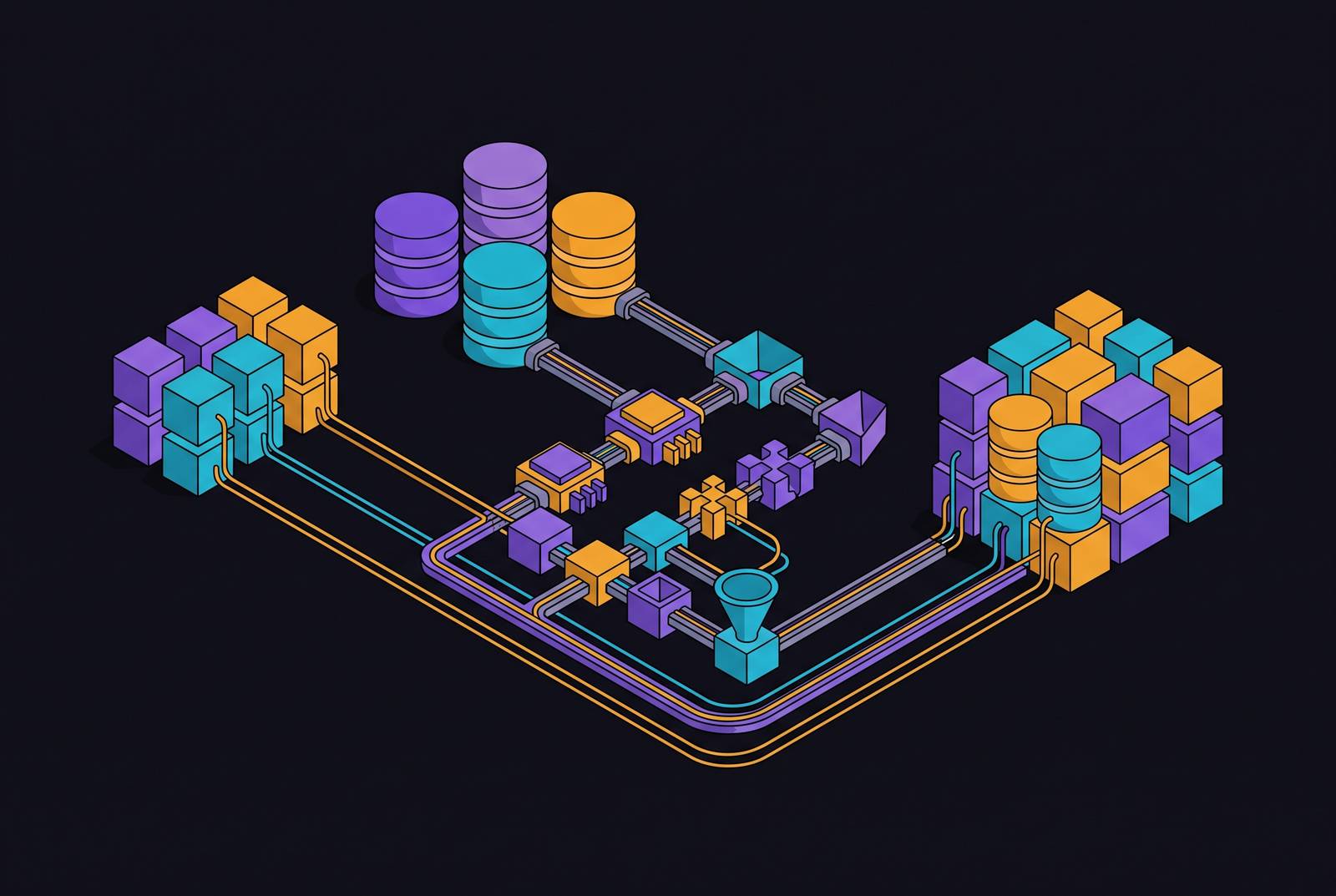
Data provenance in an ETL pipeline is not a report you generate after the fact. It's a property the pipeline either has or doesn't, decided at design time, not audit time. Most teams treat traceability as something to bolt on once a pipeline is running, and that order of operations is backwards. By the time someone needs to trace a bad number back to its source, the record of how that number was built is already gone, or scattered across five systems that were never meant to talk to each other.
The stakes aren't abstract. A survey found that 58% of business leaders admitted their companies often base critical decisions on data that's inaccurate or inconsistent. That number reflects what happens when provenance is assumed instead of enforced, when nobody can answer "where did this come from" fast enough for the answer to matter.
What data provenance and data lineage mean in an ETL context
The two terms get used interchangeably, and the confusion causes real design errors downstream.
Data provenance is the origin and derivation of a specific output: which source records fed it, through what transformations, in what order. It's tuple-level accountability. Pointing at one row in a dashboard reveals exactly which upstream records produced it and what happened to them along the way.
Data lineage is the wider map: the system-level view of how data moves and changes across an organization, which datasets feed which, where transformations happen, what breaks downstream if a source table changes shape. Lineage tells you the pipeline's topology. Provenance tells you the story of one output.
A governance program needs both, and needs to stop treating them as the same thing. Lineage without provenance gives visibility with no accountability: you can see the map but not answer for any single decision. Provenance without lineage gives accountability with no context: you can explain one output but have no idea how it fits into the larger system. Most teams default to building lineage dashboards because they're visually satisfying, and skip the harder, less demoable work of tuple-level tracing. Building lineage dashboards because they're visually satisfying while skipping the harder, less demoable work of tuple-level tracing gets the priorities backwards. Lineage looks impressive in a review meeting. Provenance is what actually gets you through an incident.
A third layer is emerging now, specific to AI: traceability that connects data provenance to model versions, prompts, outputs, access events, approvals, and incident records. The goal is reconstructing how an AI system used that data to produce a specific answer, and who signed off on what along the way.
What the extraction stage must capture for later provenance
Extraction is where provenance gets born or gets killed. If source identity, timestamp, and schema version don't get captured at the moment of the pull, nobody reconstructs them afterward. That information doesn't exist anywhere else, and no amount of downstream cleverness recovers it once it's gone.
At minimum, extraction needs to attach:
- Source system identifier: the specific database, API endpoint, file path, or stream topic the record came from.
- Extraction timestamp, meaning when the pull happened, not when the record was created in the source system. Those two times are rarely the same, and conflating them is a common source of confusion later.
- Source schema version or snapshot identifier, so schema drift can be detected and pinned to a specific point in time.
- Extraction method: full snapshot, incremental pull, or change data capture. Each represents a different slice of reality.
- Any filters or query predicates applied, because a filtered extraction is a partial view of the source and needs to be labeled as such.
Change Data Capture matters specifically here. CDC captures row-level inserts, updates, and deletes as they happen, often at sub-second latency, and preserves the change history instead of overwriting it. Tools like Estuary Flow and Debezium operate in the CDC category and are designed around this pattern. That's provenance built into the extraction pattern itself, not bolted on afterward, and it's the strongest argument for choosing CDC over a full-refresh pattern whenever the source system supports it.
There's a silo problem that starts right here. A customer record, a claim record, a candidate record: these things typically live in three or four separate systems that were never designed to reference each other. Extraction has to tag records with enough context to re-link them later, without prematurely merging identity across systems that might turn out to represent different entities. Merge too early and you lose the ability to tell the systems apart later, and that mistake is nearly impossible to undo once it's propagated downstream.
How transformation decisions break provenance
Transformation is the highest-risk stage, full stop. Every join, aggregation, filter, type cast, deduplication step, and business rule changes what the data actually represents. Without a record of those decisions, nobody explains the output: not the engineer who built the pipeline, not the analyst using the dashboard, and certainly not an auditor six months later.
A few patterns break provenance quietly and repeatedly:
- Silent deduplication, where records get merged with no log of which source record survived or why.
- Undocumented business rules, hardcoded thresholds or conditional logic applied with no metadata trail.
- Multi-source joins with no origin tagging, so an output row combines fields from two systems and nobody can tell which field came from where.
- In-place schema rewrites, column renames or type changes applied without versioning, so the same column name means two different things depending on when you look.
Preserving provenance through transformation means designing against these failure modes on purpose, not hoping they don't happen. Carry source identifiers through every join. Don't drop foreign keys just because the merge is "done," a phrase that should set off alarms in any code review. Version transformation logic the same way you'd version application code: SQL scripts, dbt models, and ETL job configs all belong in version control, so there's a permanent record of which logic version produced which output.
Log the decisions themselves. Which rule fired, with what parameters, against which schema version, at what time. Separate raw, conformed, and curated layers, the medallion pattern or something close to it, so each layer's inputs and the logic that produced it trace independently of the others. For aggregations specifically, log the source row count and any filters applied, so anyone looking at the aggregate later knows what it does and doesn't represent.
Lineage parsing tools help here too, extracting relationships by reading SQL queries, ETL scripts, and database logs after the pipeline has already run. That's a useful diagnostic, and it's genuinely handy for retrofitting visibility onto an old pipeline nobody documented properly. It is not a substitute for metadata built in at design time. Teams that treat it as one end up with lineage maps full of gaps they can't explain, because a parser can only tell you what the code says, not what the engineer meant or what edge case the join was quietly working around.
What the load stage must record to close the provenance chain
The load stage is where provenance either survives into the destination or gets stripped off at the door. This is the last chance to close the chain, and it's the stage most often treated as an afterthought, because by this point the "real work" of transformation feels finished.
Every loaded record or batch needs to carry:
- A pipeline run identifier linking it back to the specific job execution that produced it.
- The transformation version, meaning exactly which logic version was applied.
- A load timestamp and the target table or partition it landed in.
- For incremental loads, whether the record is an insert, update, or delete, and what triggered that change.
None of this matters if it only lives in job logs that get rotated out after thirty days. Provenance metadata needs to be first-class columns in the destination schema, or a companion metadata table that persists as long as the data does. Otherwise the trail ends the moment the log retention policy kicks in, and it always kicks in at the worst possible time, usually right before someone needs to answer for a number from four months back.
Immutability matters here too. Append-only storage, or warehouse features that support time travel and snapshotting, mean previous states of a record stay queryable long after they've been updated or deleted. Skipping that means the load stage erases history even when extraction and transformation did everything right upstream. All that careful metadata work gets thrown away at the very last step, which is a strange place to lose the plot after doing everything else correctly.
Fragmented logging across pipeline layers and its effect on end-to-end traceability
Every layer of infrastructure keeps its own diary, in its own language, and none of them were built to be read together.
ML frameworks like MLflow or ONNX Runtime log model inference metadata. Policy engines like OPA and DMN record rule evaluation paths. Observability platforms built on OpenTelemetry capture system health, while separate standards like OpenLineage capture data lineage. Governance frameworks, ISO 42001 or EU AI Act compliance documentation among them, specify what organizations should record without ever specifying a shared data model for how to record it. Four layers, four formats, and no single record that ties them together.
In complex multi-algorithm systems, opaque recommendations appear in pipelines when components only talk to each other through isolated API calls. An operator sees an output with no visibility into the sequence of decisions made by different algorithms that led there, and there's no shared record for that sequence to live in even if someone goes looking.
The practical cost is visible during an incident. When an AI output or a downstream report goes wrong, the audit means assembling evidence from systems that were never designed to be cross-referenced. The audit is slow because it means assembling evidence from systems that were never designed to be cross-referenced. It's often incomplete, and frequently inconclusive, because by the time someone's stitching together five different logs, the specific context that would explain the anomaly has already aged out of at least one of them. The failure isn't a missing tool, it's four or five tools that each do their job correctly and were never asked to speak to each other, and most governance documents gloss over this.
Tooling that carries provenance natively versus tooling that requires it to be added
Some tools generate provenance metadata as a built-in feature of what they do. Others leave that entirely to the team building the pipeline. The distinction matters because it decides how much design work falls on the engineers instead of the vendor, and teams routinely underestimate that cost when picking a stack.
On the native side, Apache NiFi has built-in data provenance and audit capabilities, with support for ingesting from diverse sources. It's open-source, and teams get traceability without having to instrument it separately. That is why it appears so often in regulated environments where retrofitting an audit trail isn't an option.
Informatica's PowerCenter and IDMC bring decades of enterprise ETL maturity, with IDMC in particular offering code-level lineage by parsing SQL, stored procedures, ETL logic, and even AI and ML code. That's a strong fit for organizations sitting on complex, legacy-heavy data estates. IBM DataStage covers similar ground for high-volume environments, with parallel processing and lineage features tied into IBM Knowledge Catalog, especially useful where IBM infrastructure is already in place.
Atlan works differently, building what it calls an Enterprise Data Graph that unifies data and business context so every team, and increasingly every AI agent, works from the same trusted picture. dbt fits a narrower but important niche. Transformation logic lives as version-controlled SQL, and lineage falls out of the DAG as a structural byproduct of how the tool builds models, which makes it a strong fit for ELT stacks doing transformation inside the warehouse.
On the other side sit custom Python scripts, general-purpose orchestrators like Apache Airflow, and cloud-provider ETL services. These log job execution but not record-level lineage by default, and that gap is a real cost most teams don't price in until an incident forces them to. Airflow has started shipping OpenLineage as a provider since version 2.7.0, which helps, but out of the box these tools coordinate tasks without tracking what happened to the data inside them. That's not a weakness of the tools themselves, they were built to solve orchestration, not governance. The provenance design burden sits entirely with whoever's building the pipeline, and pretending otherwise is how teams end up surprised during their first serious audit.
A 2025 framework called PROV-AGENT, presented at the IEEE International Conference on e-Science, is early academic work on unified provenance tracking for AI agent interactions in agentic workflows. It's a signal that the tooling gap for agent-based pipelines is recognized. Enterprise-grade tooling for that specific problem is still catching up, and any team building agentic pipelines today should assume they're on their own for now.
Governance structures that make provenance operationally useful rather than decorative
None of this matters if the metadata sits there unread. Organizations can fully instrument provenance and still make decisions without ever consulting it, and that's the failure mode nobody talks about enough. Logged is not the same as used. If provenance review doesn't belong to a named owner with a defined process, the trail exists on paper and changes nothing in practice.
Ownership has to be explicit, across three tiers, and vague ownership is functionally the same as no ownership. CDOs and data governance committees own context layer policy and acceptable quality thresholds, the standards against which incoming and transformed data gets judged. AI and MLOps teams own agent behavior, gateway policies, and evaluation pipelines, the layer where AI systems actually consume the data. Security and compliance teams own audit review and incident investigation, and this is the tier where it matters most that lineage records are actually usable, not buried in a ticketing system nobody opens until something's already broken.
When AI systems draw on data scattered across multiple silos, the chain of provenance has to reach past data lineage into the reasoning and approvals behind each output. Some platforms attempt to address this directly by connecting evidence, transformations, approvals, actions, and measured outcomes into a unified record, though enterprise-grade solutions for this remain nascent. That makes it possible to reconstruct not just where a piece of data came from, but how it shaped a decision and whether that decision held up against what actually happened.
Provenance built this way works as infrastructure rather than a compliance artifact, because it's designed to answer operational questions, not just satisfy auditors once a year. An organization built this way answers "why did this happen" in an afternoon. One without it spends three weeks reconstructing a story from five disconnected logs, and still isn't sure it's right.