Handling PII and Sensitive Data During Graph Ingestion
Warehouse permissions don't protect sensitive data once it enters AI retrieval layers.
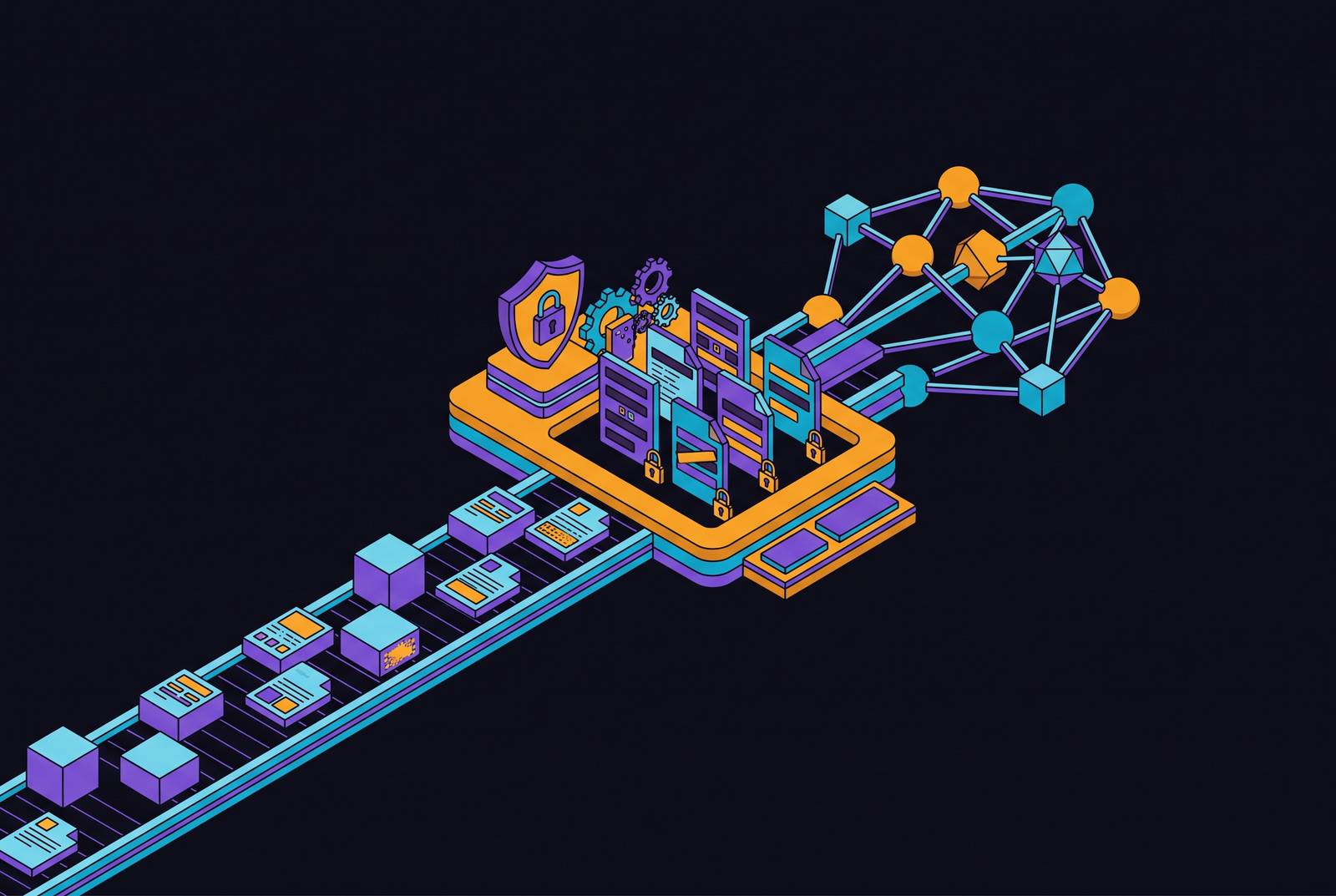
A warehouse wall used to mark the edge of the problem. Lock down who can query the table, encrypt what sits on disk, and the job was mostly done. Graph ingestion breaks that model, because the risk doesn't stay put once data crosses into a system built to retrieve, summarize, and act on it.
Storage security answers one question: who can query the system. AI delivery security answers a different one entirely: what context actually reaches the model once retrieval happens. Encryption at rest and warehouse role-based access control were built for the first question, and they do nothing for the embedding pipeline, the prompt assembly step, the retrieval layer, the tool invocation, or the path the generated output takes on its way back to a user.
Picture a customer support agent built to answer questions about order status and shipping exceptions. That's the whole job. But if the retrieval layer isn't scoped tightly, it can pull the full account bundle instead, national identifiers, medical notes buried in a support attachment, all of it. Warehouse permissions can be entirely correct in that scenario. The model's context window is still unsafe.
Four distinct routes let models expose sensitive data. Memorization during training or fine-tuning is the one most people think of first. Retrieval from context stores that were never scoped for sensitivity is another. Output generation from prompts that already carry sensitive fields is a third. The fourth is retrieval-augmented generation tuned purely for relevance, and it's the one that should worry teams most, because it requires no memorization at all to leak PII. A system can be functioning exactly as designed, optimizing for the most relevant chunk of context, and still hand a model something it should never have seen.
Shadow AI is making this worse, directionally and fast. Research from late 2025 found that a substantial share of what employees paste into external AI tools, chat logs, spreadsheets, support tickets, contains sensitive data: customer records, payment details, health information. That share has grown significantly since 2023. Nobody classified that data before it left the building. It left without ever being classified.
Put together, the lesson is blunt: a team that has locked down the warehouse but left the ingestion pipeline, the embedding job, and the retrieval layer ungoverned has secured the wrong perimeter. The wall moved. Most governance programs haven't caught up.
Why the definition of what counts as PII inside a graph has widened
Start with what actually needs protecting, because the scope is wider than most inventories assume. Any working definition of PII inside a graph has to include indirect and quasi-identifiers alongside the obvious ones, since attackers and regulators alike treat correlation as identification.
Direct identifiers are the easy part: full name, national ID, driver's license number, email, phone, biometric data. Every data protection program in existence already flags these. The harder category is indirect identifiers: IP address, device IDs, location history, purchase patterns, employment metadata, behavioral profiles. None of these identify a person on their own. Combined, they do. Graph edges exist for exactly that purpose, to connect fragments into a coherent picture. That connective purpose is what raises the stakes.
Regulated categories have multiplied too. By 2026, the list spans PII, PHI (individually identifiable health information handled by HIPAA-covered entities or their business associates), payment account data under PCI DSS v4.0.1, authentication secrets, and confidential business content, each with its own handling obligations. Treating these as one undifferentiated blob is how programs miss things.
Unstructured data compounds the difficulty of tracking where sensitive data actually lives. A PDF might have a tax ID buried in a scanned attachment nobody thought to check. A Slack export might carry an employee's health disclosure from a benefits conversation. A call transcript might include a card number an agent read aloud to confirm a payment. None of that looks like a database column. Once it gets chunked and embedded, though, it becomes retrievable context just like any structured field.
The amplifier that's specific to graphs deserves sitting with. A context graph's whole purpose is connecting meaning across silos. A person's loan application, their licensing progress, their support history, these might live in separate systems, but the graph edges that connect them for AI also make indirect identifiers correlatable at retrieval time. The graph is what makes them useful to an AI system, stitching separate records into one coherent view. That same stitching is what makes indirect identifiers correlatable at the moment of retrieval. The feature and the risk are the same mechanism.
Discovery has to classify the full range: email, phone, postal address, payment card data, national identifiers, PHI, payroll data, authentication secrets, confidential deal terms. Scope the search too narrowly, hunt only for fields with obvious names, and renamed or reformatted values slip through untouched.
Where PII commonly escapes during the ingestion pipeline itself
Exposure rarely comes from one dramatic breach. It comes from the seams between pipeline stages, the places where each team assumes someone else has it covered.
A 2026 analysis of PII protection failures found that five pathways occur repeatedly. Over-permissioned cloud data stores, where access was granted broadly at some point and never revisited. Shadow SaaS usage, employees running data through tools nobody vetted. Unstructured data sprawl across documents, chats, and PDFs. Dev and test environments replicating production data without stripping anything sensitive out first. And AI or analytics pipelines absorbing identity data without classifying it on the way in.
The static masking failure deserves its own paragraph, because it's sneaky. A field gets masked cleanly in a reporting table. Meanwhile that same value appears unmasked in a support ticket, a PDF, an event log, a cached embedding, and a feature pipeline downstream. The masking rule did its job in one place and nowhere else. This is a semantic problem, not a syntax problem, and syntax-only tooling will never catch it.
Then there's the column-rename failure, which is almost comic in how simple it is. A static rule masks a field called customer_ssn. Later, a developer ships a new field, customer_tax_identifier, holding the exact same kind of data. It's still a string. It still looks like text to any type-checker. But the masking script was written against a column name, not against the meaning of the data, so it sees a new field and skips right past it. The PII never changed. The label did, and that was enough to break the control.
Non-text formats are their own blind spot. AI search systems happily index whatever they find inside PDFs and video transcripts. OCR and named-entity recognition are supposed to catch and scrub sensitive content in these formats before indexing runs. Skipping that step, or running it after indexing instead of before, makes the sensitive content fully retrievable.
Stale embeddings might be the least forgiving failure mode of all. Once PII gets chunked and embedded without masking, that embedding becomes a durable liability sitting in a vector store. Remediate the source system all you want afterward, the re-identification risk at the retrieval layer doesn't go away. The leak already happened, it's just waiting to be queried.
Regulated industries add their own layer of difficulty on top. In finance, turning tabular datasets into machine-readable, privacy-aware knowledge graphs runs into two persistent obstacles: aligning data to a shared ontology and detecting personal data buried inside fields that were never labeled as sensitive. Neither problem is exotic. Both are common enough that pipelines built without them in mind tend to break.
The five controls that must operate at every stage of the pipeline
Closing these gaps takes five controls, and they only work as a connected chain: discovery, tagging, masking, access gating, and output, each stage handing governed context to the next.
Discovery and classification comes first. Pattern matching alone misses renamed fields, free text, and copied values scattered across systems it was never pointed at. Semantic classification, tagging by what the data means rather than what the column is called, holds up far better. The real test for a security team isn't whether a policy document exists. It's whether the organization can locate every place regulated PII lives within a defined response window and know exactly who has access to it. For anything that isn't plain text, OCR and named-entity recognition need to run before indexing, full stop, because PDFs and video transcripts are a proven way to smuggle PII past a text-only scanner.
Tagging and semantic policy attachment comes next. Policy has to follow what the data means, not what it happens to be called at a given moment. A policy attached to the concept of a Social Security Number survives a rename from ssn to tax_id_v2, because it was never tied to the label in the first place. The Data Privacy Vocabulary offers a machine-readable way to attach exactly this kind of privacy semantic to data elements inside a knowledge graph, and it's already showing up in automated pipelines built for financial data.
Dynamic masking at the delivery layer is stage three. Static masking breaks the moment an unmasked copy of the data reaches a pipeline nobody accounted for. Dynamic masking instead applies its rules at inference time, based on who's asking, which agent is asking, and why. Pseudonymization and tokenization take this further, swapping sensitive values for generic labels like [PATIENT_ID_REDACTED], so that even a compromised search index has nothing usable in it. A gateway layer inspects prompts in real time before they ever reach a model, redacting or blocking on the spot. Gravitee's AI Gateway, which added a PII filtering policy in its 4.11 release, is one working example of this kind of enforcement sitting outside the ingestion pipeline itself.
Access gating and least privilege is stage four. If a human employee can't view restricted legal notes, an AI agent shouldn't gain that access just because it's running on a more powerful backend service account. Read access and the authority to change a record need to stay separate, always. And when one agent delegates a task to another, the permissions passed along should only ever narrow, never expand. Approval gates for high-risk actions, transactions above a set dollar threshold, outbound communications, edits to production databases, keep write authority firmly decoupled from read access.
Output path and lineage closes the loop. What a security team actually needs isn't a transcript of what the model said. It's a decision trace, evidence connecting inputs, recommendations, approvals, and actions, including the attempts that failed or came back inconclusive. Atlan, named a Leader in the 2026 Gartner Magic Quadrant for D&A Governance Platforms, builds around this exact idea: classification and policy live in a context layer so that control travels with the data instead of stopping dead at the warehouse wall.
How governance structure determines whether these controls hold
They need an organization behind them willing to own the decisions and act when something goes wrong.
That means a cross-functional Agent Governance Board, and the word "governance" there has to mean something real: actual veto power over agent deployments, not an advisory committee that reviews things after the fact. It should be able to approve an agent's action authority, pause it, or kill it outright.
Accountability has to map cleanly to function, or it collapses into diffusion of responsibility, everyone assuming someone else owns the failure. CDOs and data governance committees own the policies living in the context layer. AI and MLOps teams own agent behavior, gateway configuration, and evaluation pipelines. Security and compliance teams own audit review and incident investigation. Domain teams own the data quality standards and semantic definitions specific to their own systems. Splitting it any other way opens gaps at the boundaries.
Kill-switch infrastructure belongs on this list too, not as a nice-to-have but as a baseline requirement: the ability to suspend any single agent's action authority immediately, without taking down every other workflow running alongside it. On escalation, the agent pauses, packages up its current context, and routes the whole thing to a designated human approver. Nothing resumes until that human signs off.
What does governance tooling actually look like when it's built to match this? Graphwise's Privacy and AI Governance Graph is one answer, a domain-specific model covering processing activities, data, systems, vendors, contracts, AI models, and controls, with connectors reaching into multi-cloud and hybrid environments. IBM's watsonx.governance takes a related approach, adding knowledge-graph-based visualization for exploring relationships among data assets and ontology mappings, paired with real-time data quality rule execution.
The gap between having the technology and having the governance to run it is wide, and one data point makes that plain. A 2025 study of independent insurance agencies found that only a small fraction had anything resembling a well-defined AI use policy. The tools existed. The organizational structure to govern them mostly didn't.
Where the regulatory environment now concentrates penalties
By 2026, regulation has stopped being a set of guidelines and turned into something with real teeth, and the obligations attach directly to the AI pipeline itself, not just to wherever the data happens to sit at rest.
The EU AI Act sets the tone for high-risk systems, with financial penalties for non-compliance steep enough to reorder a budget conversation. Healthcare carries its own specific exposure: standard AI architectures that violate HIPAA's Technical Safeguards are, per one analysis, a pattern affecting a large share of healthcare AI agent deployments currently in production. The financial consequences are not abstract. Per-violation fines and breach remediation costs routinely dwarf whatever it would have cost to build proper governance tooling in the first place, and 2025 already ranks as the second-highest year on record for financial penalties tied to HIPAA cases.
Shadow AI carries its own price tag too. IBM's 2025 Cost of a Data Breach Report found that breaches involving shadow AI cost meaningfully more on average than breaches without any AI involved. Trace that gap back far enough and it lands on the same root cause discussed earlier: unsanctioned tools pulling context that nobody bothered to classify before it left the building.
Insurance is watching its regulatory perimeter expand in real time. Together they sketch out a state-level compliance perimeter that barely existed a few years ago and is only getting more detailed.
None of this reads as optional anymore. The cost structure has flipped: building the five controls costs a known, bounded amount, while skipping them exposes an organization to fines, breach remediation, and liability that scale with exactly how much sensitive data slipped through unclassified. The warehouse wall was never the real edge of the risk. The pipeline is, and regulators are now pricing it that way. Insurance-specific regulatory scope is expanding, as the NAIC AI Model Bulletin state adoption map (status as of August 31, 2026) and the NY DFS Insurance Circular Letter No. 7 (2024) represent the emerging state-level compliance perimeter for AI-assisted insurance workflows.
Sources
- PII Data Protection in 2026 | Identity-Driven Security
- PII/PHI Scrubbing for AI: Security Beyond Text with SearchUnify
- How to Handle PII in AI Pipelines: Compliance Guide 2026
- How to Prevent PII Leaks in AI Systems: Automated Data Redaction for LLM Prompts
- PII Redaction in AI Systems: Why It’s Non-Negotiable in 2026
- AI Agent PII Protection: 3 Vectors to Stop [2026]
- Deontic Knowledge Graphs for Privacy Compliance in Multimodal Disaster Data Sharing
- Ontology Alignment and PII for Financial Knowledge Graph Construction | Springer Nature Link