Automated Change Detection for Production Knowledge Graphs
Keeping production knowledge graphs current without silently breaking agent reasoning chains.
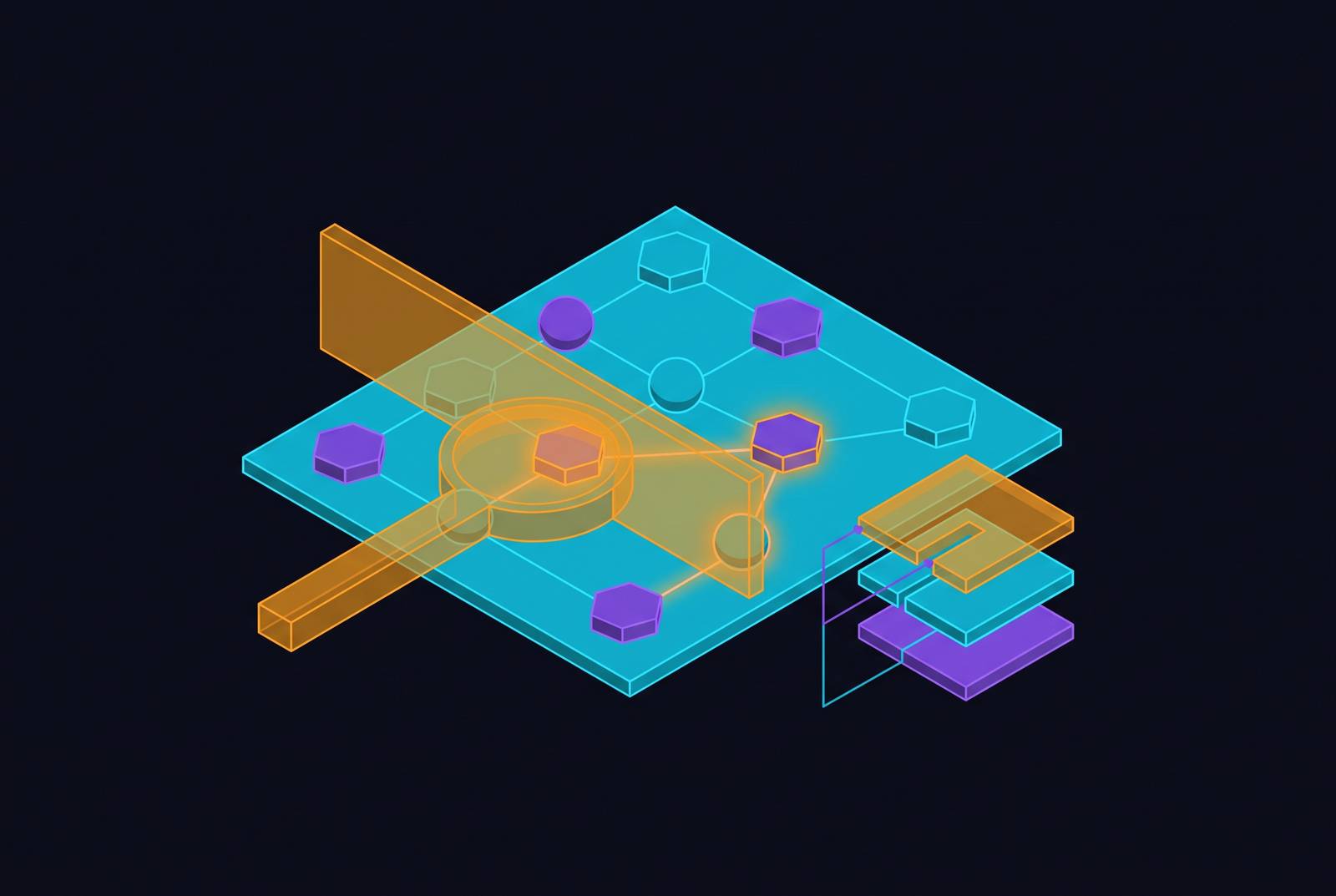
A customer account node sits in a production knowledge graph, connected to a policy record, a support ticket, a billing history. Nothing about it looks wrong. No error fires, no alert trips, no dashboard turns red. And yet the record behind it changed three weeks ago in the source system, and the graph never heard about it. That's the ordinary condition of a live production graph, not the exception to it.
Most enterprises don't actually have a shortage of data. Most enterprises have fragmentation instead: structured records in one system, unstructured documents in another, human decisions logged nowhere. Celent has noted that most policy-level data sits trapped in unstructured documents, submissions, binders, quotes, loss runs, arriving as PDFs and fragmented spreadsheets rather than clean records. A knowledge graph built against that landscape is always a partial map of a business that keeps moving underneath it, and the coverage gap over that unstructured population widens without producing any visible signal.
Schema change makes the problem worse in a specific, mechanical way. Renaming a field in a CRM leaves every edge in the graph that used that field as a relationship key carrying a connection that looks structurally fine but is semantically wrong. The edge still points somewhere. It just doesn't point at the truth anymore. This risk scales with the very thing that makes a knowledge graph valuable: the more entities and relationships it holds, the larger the surface area exposed to upstream change, and the fewer single degradation events get noticed before they matter. Staleness is a structural property of any graph built to represent a business that won't hold still.
How stale graph data compounds into bad agent decisions
Graph staleness used to be a data-quality problem that analysts cleaned up on a schedule. Agentic AI changed that calculus, because an agent doesn't read a graph the way a person skims a report. It traverses it, step by step, to plan action.
Picture an agent trying to resolve a customer issue. It needs to trace which support ticket belongs to which customer, which customer belongs to which account, which account has an open contract. Each of those is a hop across an edge. If one edge in that chain is broken or stale, the agent doesn't fail safely and stop. It keeps going, and it produces a confident traversal to the wrong place rather than a null result. Multi-hop reasoning is what a knowledge graph is built to support in agentic architectures, which is also why multi-hop reasoning is the primary channel through which staleness spreads across a decision chain.
The damage compounds from there. Suppose the agent resolves an outdated entity, matching a support request to the wrong person. Every subsequent edge it walks from that point, policy status, licensing progress, support history, gets evaluated against the wrong entity. The error is invisible to the agent, because nothing in its traversal looked anomalous. It can be just as invisible to a human reviewer checking the output afterward, because the final recommendation can look perfectly coherent. It's simply coherent about the wrong person.
The deeper issue in enterprise AI deployments is that the model has no dependable picture of the business it's reasoning about. A stale graph takes that already-incomplete picture and makes it actively misleading rather than just thin. An incomplete graph produces gaps an agent might flag. A stale graph produces false confidence an agent won't.
One working architecture discussed at KGC 2026 responded to this by refusing to let the language model handle the parts of the problem where staleness does the most damage. Deterministic graph traversal, including identity merge, version chains, and cancellation cascades, was assigned to the graph layer itself rather than left to the LLM. The reasoning behind that split is straightforward: a language model has no reliable way to know that a fact it's drawing on has since been superseded. Detecting supersession is a job for structure, not for inference.
What automated change detection does mechanically
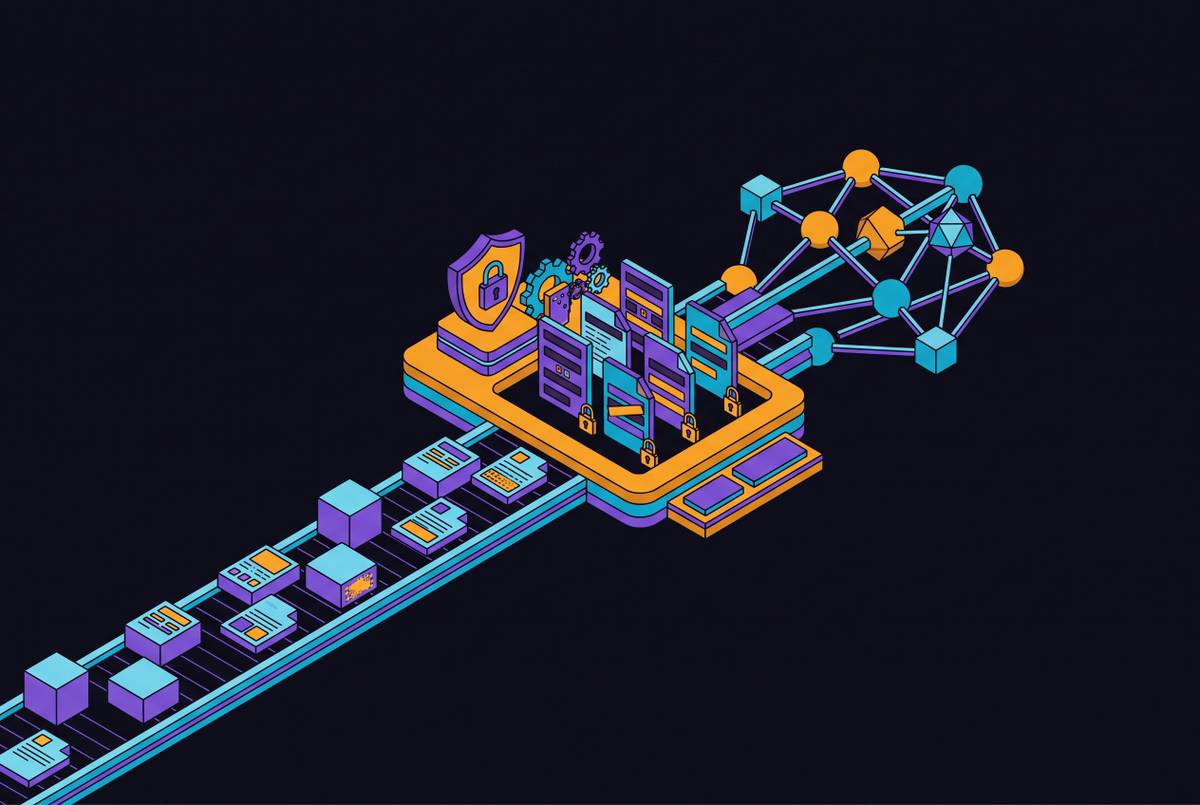
Automated change detection exists to give a graph a disciplined way to notice what the model above describes: that a fact has moved. The architecture behind much of today's production tooling traces to US Patent 11,922,326, issued to BackOffice Associates in March 2024, with a continuation issued in January 2026. Its central design choice is to separate the act of detecting a change from the act of modifying the graph. Those are treated as two distinct decisions, not one automatic pipeline.
Detection starts with triggering. A graph builder can crawl the source data storage system on a fixed schedule, respond to a notification pushed from an upstream system, or run on explicit request. That flexibility matters operationally: a fast-moving source, like a ticketing system, can be watched continuously, while a slower one, like a contract repository, can be checked on a longer cycle. The detection cadence is configurable to the velocity of change in each source domain rather than forced into one setting across the whole graph.
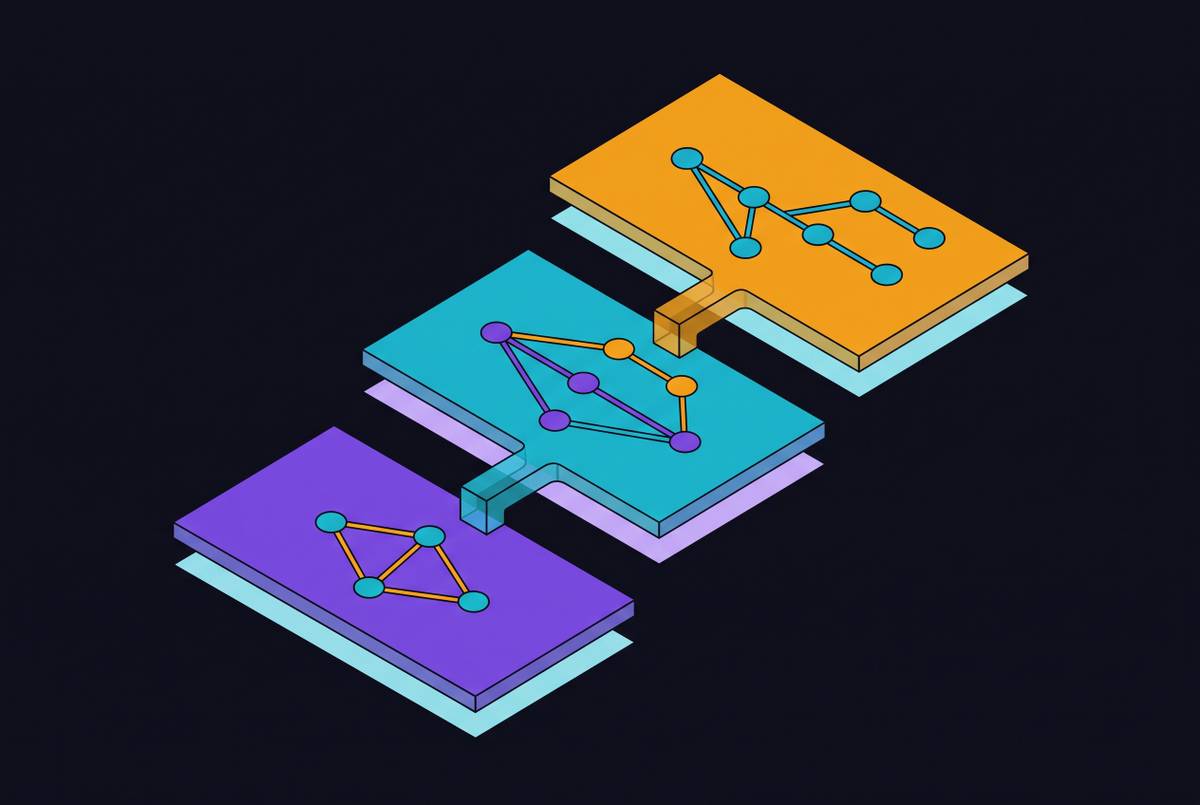
When a change is found, the system doesn't overwrite the existing record. It generates a new version node, connected back to the original root node by an edge, and that version chain becomes the auditable history of the asset. Nothing gets erased. The graph extends outward in time instead of replacing what came before, so a reviewer can walk back through what the asset looked like at each point.
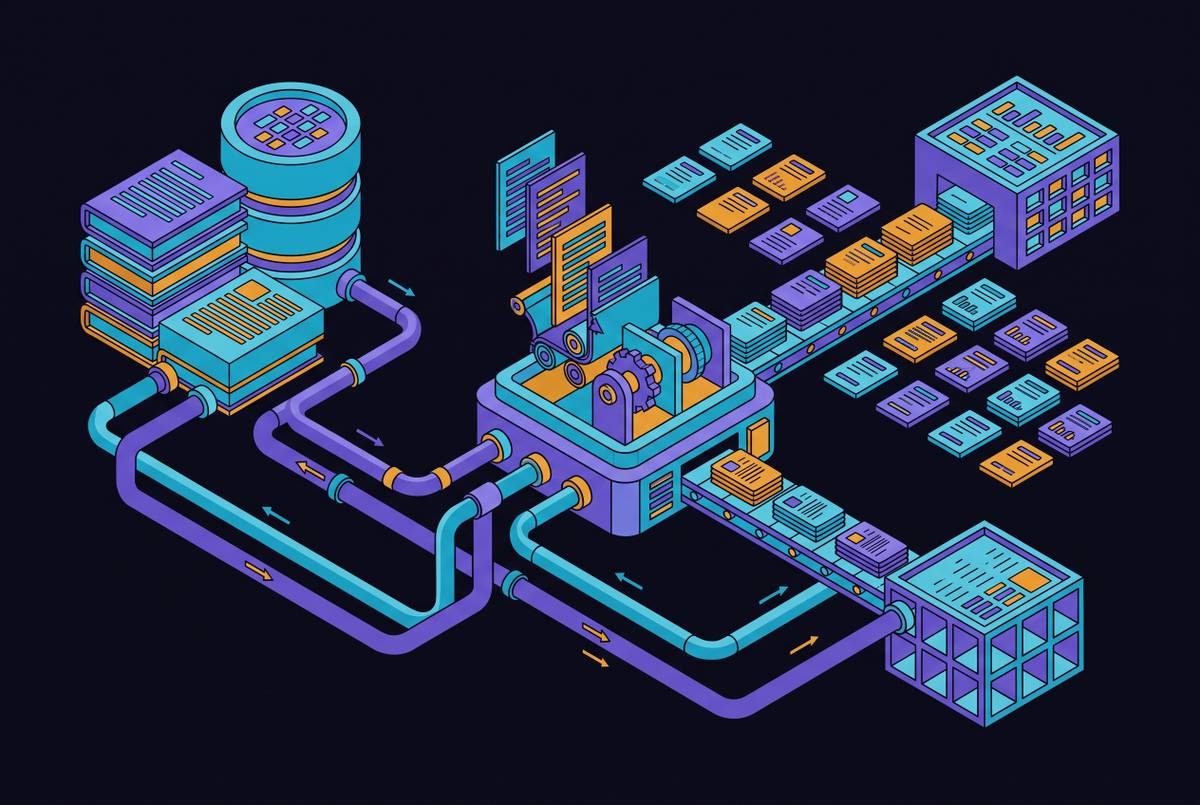
One pipeline architecture presented at KGC 2026 builds on this with an event-sourced journal running on Kuzu, which gives the full pipeline a reproducible, debuggable record end to end. In that design, language models handle the extraction work, pulling facts out of individual documents, while the graph itself performs the reconciliation across documents deterministically. The split mirrors the one from the previous section: let the model read, let the graph decide what's true.
Manufacturing offers one further example of where this is headed. A 2025 DE patent filed by Robert Bosch, noted in PatSnap's 2026 analysis of manufacturing standard operating procedures, extends this further: entity, attribute, and relationship embeddings allow missing process steps or relationships to be inferred from the graph's own learned embedding space, moving the graph from recording known changes toward inferring plausible ones and enabling adaptive procedural reasoning without manual graph maintenance.
Why detection alone is insufficient without explicit authority structures
Detecting a change and deciding what to do about it are two different problems, and collapsing them back into one is how a detection pipeline ends up recreating the governance failure it was built to solve. A system that both notices a change and silently writes it into the graph has quietly reassigned a human decision to a machine.
Traditional data governance was built around a simpler world: control who can read data, and control how it moves. Agents break that model, because agents act. They call tools, chain multiple steps together, and in a single request can write to live systems. A detection event that automatically updates a production graph, with no approval gate in between, is an agent action. It's an agent action, and it deserves the scrutiny an agent action requires.
The market is converging on this distinction as a formal requirement rather than a best practice. Collibra's runtime governance tools, Live Map, Maestro, Guardian Agents, and Agent Contracts, were presented at GraphSummit on September 25, 2026, aimed squarely at this gap. The framing offered there, attributed to Van de Maele, described the cost of skipping this layer as a "hallucination tax," the accumulated burden of manual verification and rework that builds up when agents act on graph state nobody confirmed.
The BackOffice Associates patent architecture already builds this separation into its structure. A suggestion node is generated automatically once a change is detected. Writing an actual new node or edge into the production graph typically requires an explicit accept action from a person, though the patent does leave room for automatic implementation without user input in some configurations. Read access and write permission are kept structurally distinct: noticing something is not the same authority as acting on it.
Graduated human oversight calibrated to action reversibility
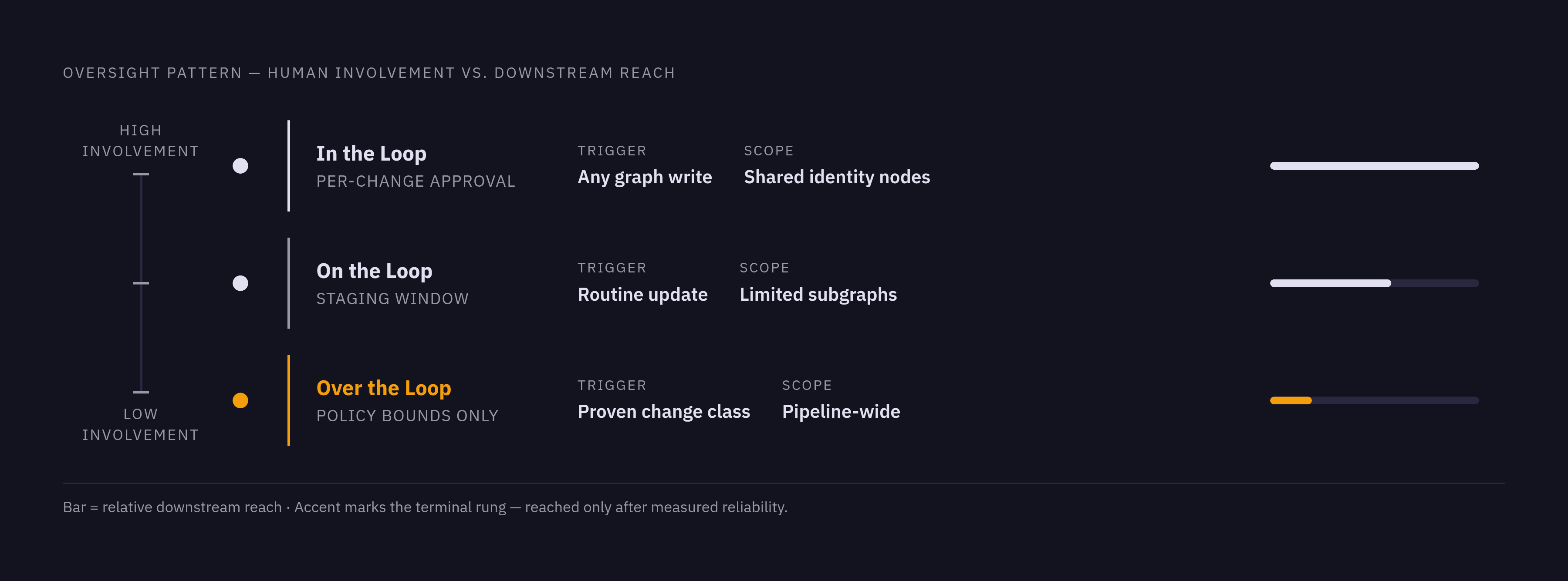
Which changes need which level of human involvement should be decided by how reversible the change is and how far its consequences reach, weighed against how confident the detection system claims to be.
Three graduated patterns cover most of what an automated change-detection pipeline encounters.
- Human in the loop: the system proposes a new node or edge, and a data steward has to approve it before the graph changes. This fits entities with broad downstream dependencies, a shared customer identity node touched by multiple workflows is a clear example.
- Human on the loop: the system writes the change to a staging graph and alerts the steward, who can intervene within a defined window before it goes live. This fits routine relationship updates in subgraphs with limited downstream reach.
- Human over the loop: the team sets policies, risk limits, and escalation paths for an entire class of change in advance, and the pipeline then executes within those bounds without review on each individual instance. This is appropriate only once a class of change has shown it's reliable over a measured period of operation.
None of these patterns works unless the human in the loop actually has what oversight requires: enough information and enough time to review, a working understanding of where the system tends to fail, the real ability to override a suggestion, freedom from pressure to rubber-stamp every recommendation, and clarity about when to escalate instead of decide alone. Oversight missing any one of those conditions is oversight in name only.
The KGC 2026 working architecture shows what this looks like applied concretely. Language model extraction feeds facts into the graph, but version chains, identity merges, and cancellation cascades are handled deterministically by the graph layer itself. Structural changes with high reversibility can run on automation. Semantic changes with low reversibility route to a person.
None of this is fixed at deployment and left alone. Regulatory requirements shift, agents gain new capabilities, and a node that once carried light dependency can accumulate heavy reliance over time, all of which change how costly a wrong update becomes. The calibration behind these three patterns needs a recurring review schedule.
Weighing the cost of undetected staleness against the cost of a false-positive update
Every automated detection pipeline runs on a threshold: how confident does the system need to be before it surfaces a suggestion at all. That threshold is a trade-off calibrated to specific costs, not a technical dial to tune toward some abstract ideal of accuracy. It's a trade-off between the cost of two different failure modes, and setting it requires weighing one against the other rather than minimizing either in isolation.
The first failure mode is a stale graph quietly poisoning the agents that depend on it. An undetected change means every agent query touching that node or edge inherits the error, and the damage compounds with each decision built on top of it. Often there's no way to catch this until an actual outcome turns out wrong, at which point the question becomes how far back the error traveled.
The second failure mode runs the opposite direction. A false positive, an erroneous suggestion accepted without adequate review, introduces an incorrect node or edge directly into the production graph. Downstream agents then reason over a structure that looks confident and complete but is simply wrong, and that kind of error can be harder to catch than a gap in the data, because nothing about it looks missing.
A practical way to size up any proposed automated graph action is to run it against a short checklist:
- Who is affected, and what's at stake for their rights or finances?
- How many downstream workflows depend on this entity or edge?
- How reversible is the update if it turns out to be wrong?
- How sensitive is the underlying data?
- How much autonomy is the detection pipeline being given here?
- How detectable would a failure actually be?
- Does this entity type carry regulatory significance?
Dynamic knowledge graphs that learn continuously from production data can identify patterns and anomalies tied to faults, and that same learning capability doubles as a feedback signal for tuning detection thresholds over time, as the system builds a record of which change types produce trustworthy suggestions and which produce noise.
Getting this calibration wrong in either direction is costly. Heavy controls on harmless, low-stakes changes slow down the graph's ability to stay current for no real benefit. Weak controls on high-impact entity types let compounding errors travel straight through to consequential decisions with nothing in the way. The full cost comparison has to account for all of it: the cost of running the detection pipeline itself, the time a human reviewer spends on each suggestion, the rework required when a false positive gets accepted and has to be corrected later, and the ongoing cost of monitoring to catch that a correction is even needed. Time saved on the detection side and money saved on the error-avoidance side are two separate ledgers, and both belong in the calculation.
Audit logs, forgetting ledgers, and the governance infrastructure the detection pipeline requires
A detection pipeline that can't explain why it made a suggestion, who approved or rejected it, and what the graph looked like immediately before and after, gives an organization nothing to learn from and nothing to defend later. Accountability requires a record alongside a result.
The event-sourced journal built on Kuzu, discussed at KGC 2026, extends this principle to the entire pipeline rather than just the graph's version history. Every extraction, every reconciliation, every write to the graph is logged as a reproducible sequence, so the pipeline stays debuggable and the full outcome history stays available for review. That log is what turns a one-off correction into an organizational memory: the next time a similar suggestion comes through, there's a prior case to check it against.
A complementary structure sometimes called a forgetting ledger captures the other side of this same discipline: a record of module, old state, new state, reason, time, and evidence for every knowledge transition in the graph. When a node is deprecated, merged, or overwritten, that transition gets a reason attached to it and a timestamp, replacing a new value sitting where the old one used to be.
None of this is bookkeeping for its own sake. A version chain without a reason attached is a history nobody can interpret later. A suggestion node without an audit trail is an approval nobody can account for. That record is what lets an enterprise trust a graph enough to let agents act on it, and that trust is the entire point of building the graph.
Sources
- Data management suggestions from knowledge graph actions
- Data management suggestions from knowledge graph actions
- Knowledge Graph for Manufacturing SOP — 2026
- Machine Learning Knowledge Graphs: 2026 Guide
- Notes from KGC 2026. What the knowledge graph community is…
- Collibra brings runtime governance to enterprise AI agents - SiliconANGLE