What an AI Forward-Deployed Engineer Actually Does
The engineer who bridges pilots and production by embedding inside customer systems.
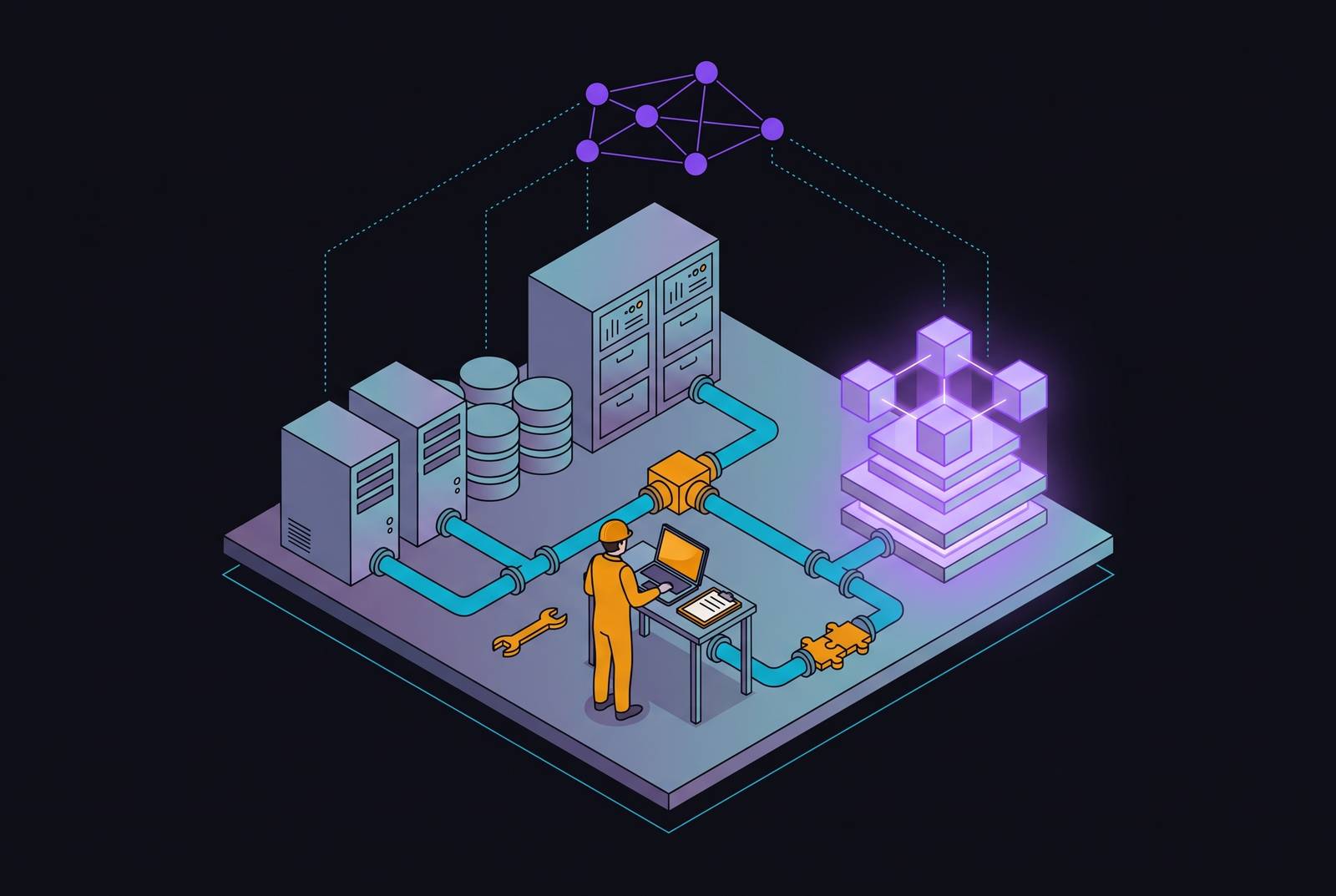
An AI forward-deployed engineer moves an enterprise AI pilot into daily use. They clarify goals, map data, build connections between systems, set approval rules, and test results. The main output is not just a working connection. It is a governed workflow and business knowledge the company keeps.
Why enterprise AI gets stuck between a pilot and real use
MIT NANDA's 2025 report found that most enterprise AI pilots showed no measurable business impact. The report blamed a "learning gap" and failures in how organisations were set up and how systems were connected. A pilot works under ideal conditions with curated data and close oversight. Real use removes that protection. The system must work across older infrastructure, permission rules, compliance requirements, and the habits of the people expected to use it. In regulated industries, a failure can mean a compliance violation or a damaged customer relationship. That is why governance must be part of the design from the start.
What does an AI forward-deployed engineer do, and how is that different from consulting or customer success?
An AI forward-deployed engineer is a software engineer who works inside the customer's environment. They write production code against its systems and stay until the workflow runs. Getting the system into production is the defining responsibility of the role. The engagement may be on-site, hybrid, remote, or inside a customer's private cloud environment. Location does not define it. Accountability does.
Consultants recommend what to do. Customer success managers handle onboarding. A forward-deployed engineer owns the build and keeps iterating until the system runs in production. That work bridges two kinds of knowledge. Your team understands its data structures, compliance requirements, older architecture, and special cases. The AI team understands how the model behaves, where retrieval fails at scale, and how to judge output quality.
Neither side has the complete picture on its own. Standard software onboarding suits predictable products with documented interfaces and clear setup steps. Enterprise AI introduces connection problems specific to your data and risk level. A standard setup process is not enough. The embedded engagement brings what both teams know to bear on one workflow. Its phases turn that shared understanding into a system the company can operate.
Phase 1: Agree on the goal and a clear measure of success before connecting anything
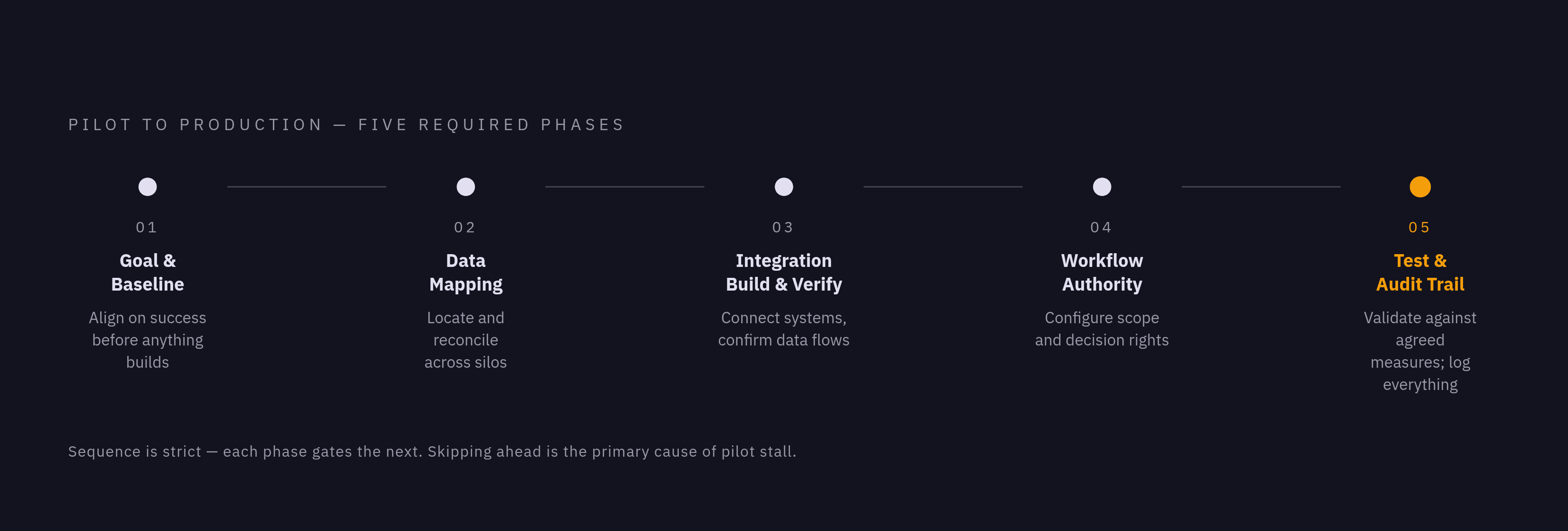
Before connecting anything, the engineer gets agreement on the specific workflow. They also establish who is accountable for it and what measurable outcome the company wants. "Improve X with AI" does not give anyone a clear way to judge success or failure. You also need someone responsible for measurement and a defined measurement period. Those decisions make it possible to compare acting now with waiting or continuing the current process.
The full cost assessment covers building, connecting, and using the AI. It also covers human review, corrections, managing change, and ongoing monitoring. Estimates are kept separate from results seen during the engagement. That way, potential value cannot quietly become reported value before the workflow has demonstrated anything. A structured summary records findings, assumptions, evidence gaps, options, and the estimated costs of acting or waiting.
Failure also needs a clear definition at this stage. A mistake that is immediately visible and easy to undo calls for different controls than one that is hard to detect or reverse. The engineer sets initial limits on what the AI can do before it touches any system. These limits spell out which decisions the AI may make on its own, which need a named person to approve, and which actions are off-limits entirely. The details of setup come later, but the limits start here.
Phase 2: Map where the data lives and build a shared picture of what it means
Data mapping means working out where the relevant information lives, who owns it, and what it means within the workflow. Moving records is not the same as understanding them. In an insurance licensing workflow, the application, licensing progress, and support history for one person may sit in separate systems. The engineer must connect those records as information about the same person and the same process. Without that shared meaning, access to all three systems still leaves the AI with an incomplete picture.
The scope covers more than structured business records. The workflow may also need information from documents, conversations, human judgement, and events outside the business. The engineer identifies which sources are relevant rather than treating every available source as necessary. This phase also establishes what cannot cross system boundaries. Compliance rules, access controls, or requirements about where data must be stored set those limits. Those limits shape the design before any connection code is written.
A connected map of company records links business meaning and relationships across existing systems. Its purpose is straightforward: it makes company information useful to the AI in the context of a specific task. Without it, the system is left to interpret disconnected records. The connections built in the next phase depend on knowing both what the data means and where it may go.
Phase 3: Build and check each connection against the customer's real environment
Building connections means writing production code inside the customer's infrastructure. Each connection is then checked against the real environment. Documentation is a starting point. Older systems can behave differently from their documentation. A connection that looks sound on paper may not support the intended workflow. Standard interfaces and file exports provide routes between business systems and AI workflows, but each connection still needs to be verified where it will actually run. Custom connectors require the same discipline.
Access has more than one meaning here. Permission to read a record does not grant permission to change it or act on it. The engineer sets those permissions separately while working within the customer's compliance rules and change approval process. In financial services, healthcare, and government, data handling requirements may also require models to run inside customer-controlled infrastructure, such as a private cloud or on-site deployment. The design must meet those needs. A public interface is used only if conditions allow it.
A Fortune 1000 insurance carrier's private cloud hiring engagement shows why design fit matters. It completed legal approval and moved from contract to production within weeks. Six prior AI hiring vendors had been rejected on design grounds over 18 months. The contrast is about design. It does not establish that building connections alone produced the hiring outcome or accounted for the full delivery schedule.
Phase 4: Set up workflows with clear approval rules, named approvers, and owners for exceptions
Once the connections are in place, setup defines what may run through them. These are organisational decisions expressed in code and policy. The company must decide what the AI can decide, what it can carry out, who approves consequential actions, and who owns exceptions. Deciding and doing are separate. An AI may be allowed to recommend an action without being allowed to carry it out.
How those boundaries work depends on the risk. An AI may automatically retry a failed low-stakes step. A consequential or irreversible action gets routed to a named approver. Limits can cover spending thresholds, systems the AI may write to, and outbound messages. Access rules restrict the tools and information available to each AI agent (a piece of software that takes actions on behalf of a user). The engineer encodes these choices rather than substituting technical defaults for decisions the business has not made.
An agent inventory records every AI agent, its owner, its purpose, and the models and tools it uses. If an employee leaves without someone named to take over, an agent can keep running without anyone clearly responsible for what it does. Approval gates, role-based access, activity logs, monitoring, and controls to pause or stop an agent all belong in the setup as operating controls.
An AI agent standards initiative was newly launched as of February 2026 and had no enforceable rules yet. The team doing the work has to design much of this itself. The absence of a mandated standard does not resolve who should approve an exception or stop an agent. Before the system runs in production, it still needs named owners and clear limits for those decisions.
Phase 5: Test against the agreed measures and build a clear record of what happened and why
The engineer measures the configured workflow against the baseline, success measures, and measurement period agreed before any connections were built. Tests of individual features cannot show whether the company got a better outcome. Time saved must be counted separately from cash savings. Estimated value must be counted separately from realised value. Failed or inconclusive results belong in the record too.
Whether those results hold up under scrutiny depends on the quality of the record. A log that captures only the final approved action does not show what the human reviewer saw, changed, or took time to consider. An "Approved" tag is not enough evidence. Grounding outputs in verified business data and showing the supporting sources lets a reviewer examine why a recommendation was made. Linking that evidence to human reasoning, approvals, actions, and measured outcomes gives the decision record uses beyond showing what happened.
The "HITL theater" problem describes human overseers nominally approving decisions they cannot meaningfully check. A checkbox does not solve that problem. Under EU AI Act Article 14, high-risk systems must have human oversight. COSO's February 2026 guidance on AI recommends it too. The engineer's task is to build the supporting infrastructure. Corrections and explanations of exceptions help make the human contribution visible.
Testing also supplies evidence for expanding what an AI agent can do on its own. Teams can start with investigation and recommendations, then allow the agent to act more as quality and value are demonstrated. Before reusing lessons from earlier decisions, check what has changed. A past approval is evidence about a past situation.
What the company keeps after the engagement: stored knowledge, flexible models, and room to expand
A well-run engagement leaves more than a working first workflow. The company keeps a connected map of company records, a decision record, and governance setup that later models and agents can use. They do not need to rebuild the underlying business knowledge. That knowledge has a life beyond the initial build. It connects what the company knows about its records with what people learned from decisions, corrections, and outcomes. Keeping it changes the value of the engagement from a one-time build to a foundation for further work.
The choice of AI model can then be assessed on its own terms. With a design that is not tied to one model, you can still use your business rules, context, and decision record when a better or cheaper model becomes available. The models still need to be compared for quality, speed, risk, and the total cost of AI plus human work. How well a model performs on a benchmark alone cannot answer those questions. Expanding to other parts of the business follows the same steps as the first deployment. Start with a named workflow, an accountable owner, and a measurable outcome once production quality and value have been demonstrated.
Nodes AI FDE is one option for this work. It clarifies goals and builds, configures, and tests connections and workflows that its Engine uses to investigate and carry out approved work. Its platform supports custom connectors built from documentation and verified against the customer environment. It also supports connections through standard interfaces and file exports, routing that is not tied to one model, and customer retention of the connected map of company records, decision records, and outcome history. The company retains its application and platform intellectual property.
Who owns what needs to be clear before a contract is signed. Some companies build their own forward-deployed engineer teams to keep knowledge about proprietary processes in-house and limit how much access vendors have to competitive workflows. An external engagement therefore needs clear answers about what the customer retains. The practical questions for you as a company leader are: who owns the decision record, who keeps the connection setup, and can the knowledge built during the engagement be moved or is it tied to the vendor's platform? Those answers show what the company can still use when the first workflow, model, or vendor changes.