Entity Resolution: Matching ERP and CRM Records Correctly
Unify fragmented customer records to prevent errors from spreading through automated workflows.
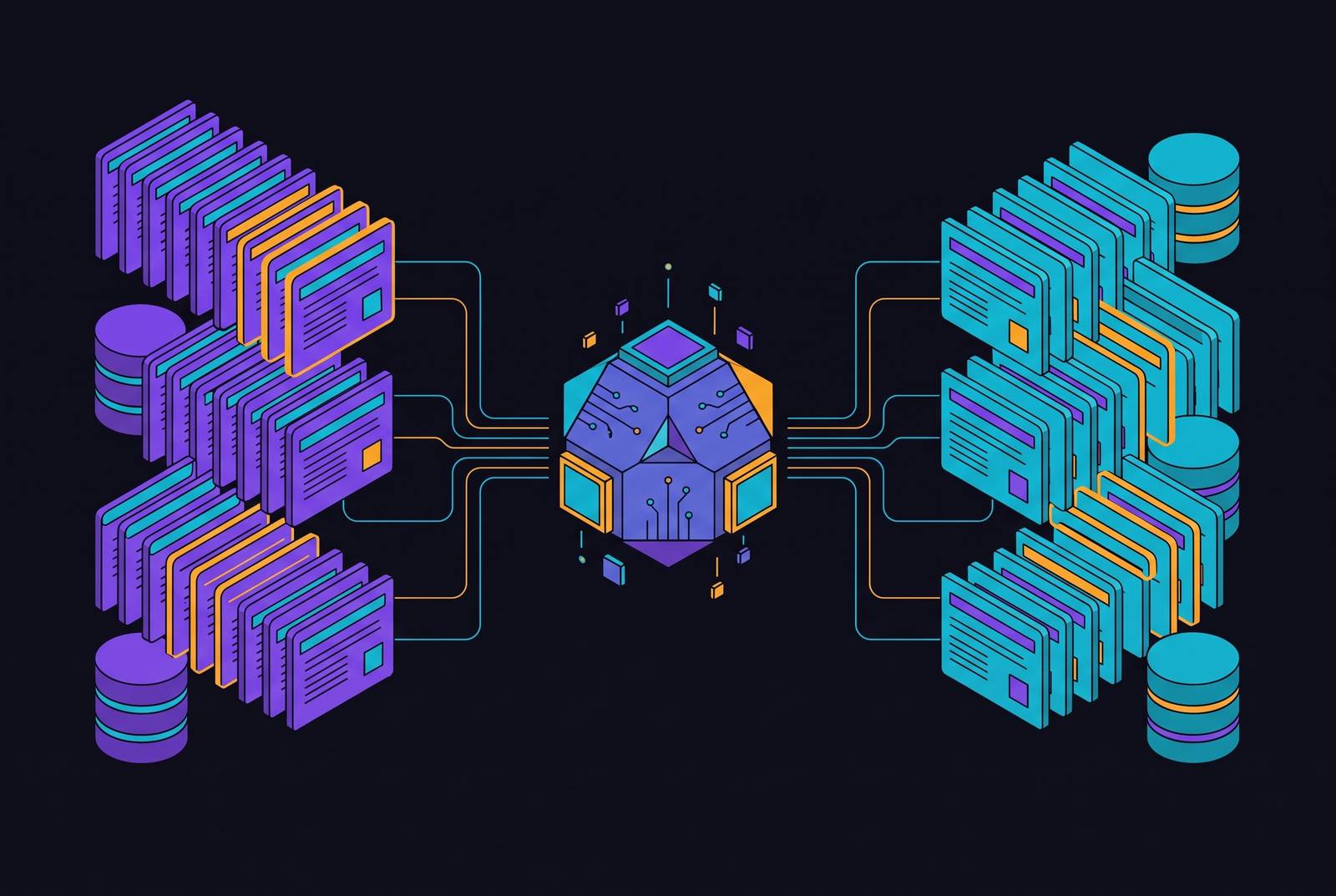
Different software systems inside the same company often store the same customer as three separate records with slightly different names. Entity resolution is the process of figuring out which records describe the same real person or company. Then you merge them into one reliable version.
Why ERP and CRM systems end up with duplicate records for the same customer
The fragmentation is not a typo or a one-off mistake. It comes from how these systems were built.
Older software makes the problem worse over time. Stack procurement tools, finance systems, and sales platforms on top of each other. A single real-world company becomes a handful of look-alike records. No simple search can connect them automatically.
Entity resolution decides whether records refer to the same real person or company. Those records might sit in one system or across several. It answers a question no individual system was built to answer on its own: is this the same customer, supplier, or account showing up again under a different name?
The damage of leaving this unresolved shows up in the numbers that leadership relies on. Every decision built on those numbers inherits the same error. That includes customer counts, risk scores, procurement analysis, and AI outputs. As more decisions get handed to automated workflows, the speed at which errors spread changes the stakes considerably.
Why this is harder than just removing duplicates
Resolving records across ERP and CRM systems is a different kind of problem from cleaning up one messy spreadsheet. Removing duplicates finds repeated rows inside a single file or system. Entity resolution has to reason across systems that store the same facts under different field names, different formats, and different rules about what counts as a unique record.
Matching tools that follow fixed rules run into trouble the moment the input gets messy. Without a shared ID connecting the systems, matching has to work from combined evidence. That means names, addresses, phone formats, and secondary identifiers. The system has to judge which pieces of evidence carry weight. A passport number tells you a lot more about identity than a first name does.
Getting the match wrong in either direction carries real cost. Failing to connect two records that describe the same entity leaves the picture incomplete. Merging records that should have stayed separate attaches the wrong history, the wrong risk profile, and the wrong transactions to the wrong person. Both kinds of mistakes travel downstream into every report and every workflow built on that record.
The stakes change again when automated software agents start acting on this data directly. An agent doesn't pause. One agent's output becomes the next agent's input. A single unresolved identity can move through procurement, invoicing, or fraud-detection logic before anyone notices the error. Identity data has to be accurate and current at every moment an agent touches it, because nothing downstream will catch what it misses.
The difference in cost between a human error and an automated error is stark. When a human analyst acts on bad identity data, the cost is usually a delay while someone fixes the record. When an automated agent acts on the same bad data, the cost can be a blocked legitimate customer, an approved fraudulent one, a poor procurement decision, or a missed compliance signal. The action may already be hard to reverse by the time anyone looks at it. This is roughly where the 1:10:100 rule applies: catching an identity error at the point of entry costs far less than catching it after it has spread through procurement, invoicing, or compliance workflows. Errors get more expensive the further they travel.
How raw records become one reliable master record
Entity resolution works as a pipeline, not a single step. The first step is standardisation. Before any matching can start, the system has to classify what each field represents. That means names, addresses, and identifiers. It also decides how much weight each one deserves in a match decision.
Next comes blocking. Once a dataset reaches enterprise size, comparing every record against every other record is not practical. Blocking narrows the field to likely candidates before the system spends computing power on detailed scoring.
Scoring is where the real judgment happens. Rather than comparing two records in isolation, entity-based matching compares each incoming record against the full profile of an entity built from every source already loaded. That approach catches connections a simple pair-by-pair comparison would miss.
Once records are judged to match, the system has to decide which values survive into the merged record. Someone has to set that rule. That rule has to be documented.
Every resolved entity gets a stable master identity. That identity stays consistent across every future matching run. New data arriving later gets matched against entities that are already resolved, without reprocessing the entire dataset from scratch. That stability lets the system scale over years instead of starting over every time new source data arrives.
AI-powered resolution has changed what is possible at the matching step. But ambiguous cases still need a person to review them. Mature setups combine fixed rules for high-certainty matches, statistical and machine-learning matching for the ambiguous middle, relationship context for connected records, and a human review queue for edge cases none of the automated layers can confidently resolve.
Resolution also has to go beyond simple identity matching into relationships. If you resolve the identity without resolving the relationship between connected entities, real risk and real opportunity stay invisible to anyone looking at the data. This relationship layer feeds into a company's broader connected data graph. That is the structure that links resolved entities to the decisions and actions built on top of them.
What a solid matching process requires beyond the algorithm
A resolution programme lives or dies on process, not just on the quality of its matching algorithm. The algorithm produces candidates. The process turns those candidates into decisions.
Setting the confidence threshold — the point at which a match is certain enough to act on — belongs to the business, not to the tool.
Workflows need defined owners for unclear cases. These are people trained to apply consistent rules when checking or rejecting an ambiguous match. If a decision matters, a person reviews it before anything gets actioned. Confirmed matches earn the stable master identifier. Anything unconfirmed stays in the queue until someone resolves it.
Keeping the programme honest over time depends on maintaining a truth set. This is a curated sample of match and non-match decisions that are already known to be correct. Regular error review between the technical team and the business owner closes the loop. It feeds adjustments back into the rules and thresholds. Every adjustment gets logged as part of the audit trail.
Entity resolution and master data management (MDM — the practice of keeping one authoritative version of key data across a company) work together, but they are not the same thing. Resolution answers which records describe the same entity. MDM adds the layer on top: rules for which values survive a merge, stewardship, workflow, and the authoritative master record that operational systems use day to day.
Where matching ERP and CRM records delivers the most concrete business value
A handful of workflows are where resolved entity data changes outcomes most directly. These are the right place to start a resolution programme.
Supplier and procurement workflows show the cost of fragmentation in a different form. Resolving supplier identity at the master level removes the root cause.
Fraud and compliance workflows depend on resolution the most directly. Entity resolution underlies fraud detection, compliance monitoring, customer intelligence, and AI-driven decision-making. Fraud patterns only surface once identity is resolved across all the variants a fraudster might use.
The payoff compounds once resolved entities stop being just a cleaner report and start feeding automated agent context directly. If that connected data graph links fragments instead of resolved entities, the agent's reasoning starts from a corrupted foundation before it even begins.
Start narrow by design: one named workflow, one accountable owner, a measurable outcome. Agree on the baseline entity count and match quality before you deploy. That way any improvement afterward is something you can actually observe and attribute to the work done.
What AI-powered tools still need humans to do
AI-native resolution tools have pushed furthest on unstructured data. They have also made the work more accessible without a large engineering team. But the governance questions still belong to people. That includes who reviews a match, who owns a decision, and which value survives a merge.
WinPure's EntityAI takes an entity-based approach: it compares each incoming record against the full profile of an entity built from every source already loaded. It offers configurable confidence thresholds, match explanations for each matched group, and stable master identity assignment. It is built for data teams that want to run resolution on their own systems without needing a dedicated engineering team to operate it.
Tamr gives you an AI-native master data platform with real-time entity resolution. It pairs AI and machine-learning models with a set of fixed rules to support governed match-and-merge workflows at enterprise scale.
Each of these tools fits a different buyer. The right choice depends on where the resolution work needs to sit, and what else it needs to connect to.
Keeping humans in control when automated agents act on resolved entity data
Most organisations that have put automated agents to work against ERP and CRM data have not built oversight to match the pace of that deployment. Agents often reach core business platforms — ERP, CRM, financial systems — well before the controls needed to govern that access are fully in place.
A mature oversight model needs five specific controls. A general policy statement is not enough.
You need a person to approve high-impact actions within limits they set. The record behind that approval should show who requested the action, every agent involved in the chain, the original task, and the decision made at each step.
Automated checks have to watch agent behaviour as it happens, not just after the fact.
An audit trail ties all of this together. People add corrections where needed and explain exceptions directly. The system checks for changed conditions before it reuses a prior decision.
Regulators are turning governed agent access into a requirement. Showing compliance means having the audit trail, the approval records, and the ability to revoke access in place and ready to show. It is not enough to say a policy exists on paper. Oversight should cover agents the organisation did not build itself, checked case by case, not just the ones built in-house.
Where you run a resolution workload, and why that is a legal question first
Where you run an entity resolution workload is, above anything else, a data sovereignty decision. That means a question about which laws govern where data can be stored and processed. The technology choices follow from that, not the other way around.
Customer personal data, identity verification records, and credit data all carry legal obligations. Those obligations decide whether cloud, private cloud, or on-premises deployment is permitted. That covers US-incorporated companies directly. It also reaches foreign providers with US subsidiaries or enough US presence to qualify. When information is classified or nationally sensitive, organisations tend to move toward fully isolated environments. No outside service can reach the resolution model or the connected data graph in those setups.
Each deployment model carries real trade-offs, and none of them is the right answer by default. Cloud-based AI services offer fast setup and flexible scale. But they require clear contract terms on how data gets used for training, whether models get shared, and how data is kept separate between customers. On-premises deployment gives you the strongest data sovereignty position and can cost less over a long, sustained workload. But it needs a full in-house operations team and takes longer to stand up than a cloud option does.
Using an architecture that is not tied to one specific AI model protects the investment you have already made in your connected data graph and resolution history. If the resolution model, the downstream AI, or the agent framework gets swapped out, a company that tied its entity graph to one specific model has to rebuild everything it accumulated. A model-agnostic design lets a new model pick up the company's existing context, business rules, decision history, and permitted actions without starting over.
Comparing the cost of acting on bad data, waiting, and resolving poorly
Deciding whether to invest in entity resolution means weighing three distinct costs against each other: acting on bad data, delaying resolution, and resolving poorly.
Acting on bad entity data in an automated pipeline costs more than a single wrong report. The 1:10:100 rule captures this clearly. An error caught at the point of entry costs far less to fix than the same error caught after it has spread through procurement, invoicing, or compliance workflows.
Delaying resolution has its own cost. That cost is also competitive. Organisations that resolve identity early can put automated agents to work with more confidence and give them more authority to act.
Resolving poorly carries its own damage, distinct from the other two. A programme that merges too aggressively does as much harm as one that leaves too many duplicates. Merging accounts that should have stayed separate creates legal exposure. It leads to commercial decisions made on the wrong basis. Those mistakes can be genuinely difficult to unwind once they have been acted on.
Before any resolution programme gets deployed, agree on the baseline. That means the success measures, who owns measurement, and the time period being evaluated. That way improvement is something you can actually observe. Many teams start with investigation and recommendations only — read access with no permission to write. Then they earn the authority to act as quality and value get demonstrated in practice. That staged approach ties this comparison to one named workflow, one accountable owner, a baseline agreed before anything goes live, and a measure of whether the data is finally trustworthy enough to act on.