How to Partition a Large Enterprise Knowledge Graph
Domain partitioning boosts accuracy and consistency where monolithic graphs fail under complexity.
Building one giant knowledge graph for a whole company makes it break under its own complexity. The fix is domain partitioning. That means splitting the graph into separate, clearly bounded sections. Controlled connections link the sections together. This keeps the data accurate, manageable, and useful.
Why one giant knowledge graph breaks at company scale
The problem starts with conflicting definitions. Finance defines an "active customer" using payment history. Marketing defines it using engagement. Put both definitions on one record with no rule saying which applies where, and the system gives you a confident wrong answer. This is not a problem of too much data or a weak search algorithm. It is a structural problem.
Springer World Wide Web names the core problem "Semantic Reduction." Rich business meaning gets flattened into plain storage records. That strips out context. It creates isolated data silos instead of connected knowledge. It also confuses AI models that try to generate answers. The same entity carries conflicting definitions with no boundary to say which one to use.
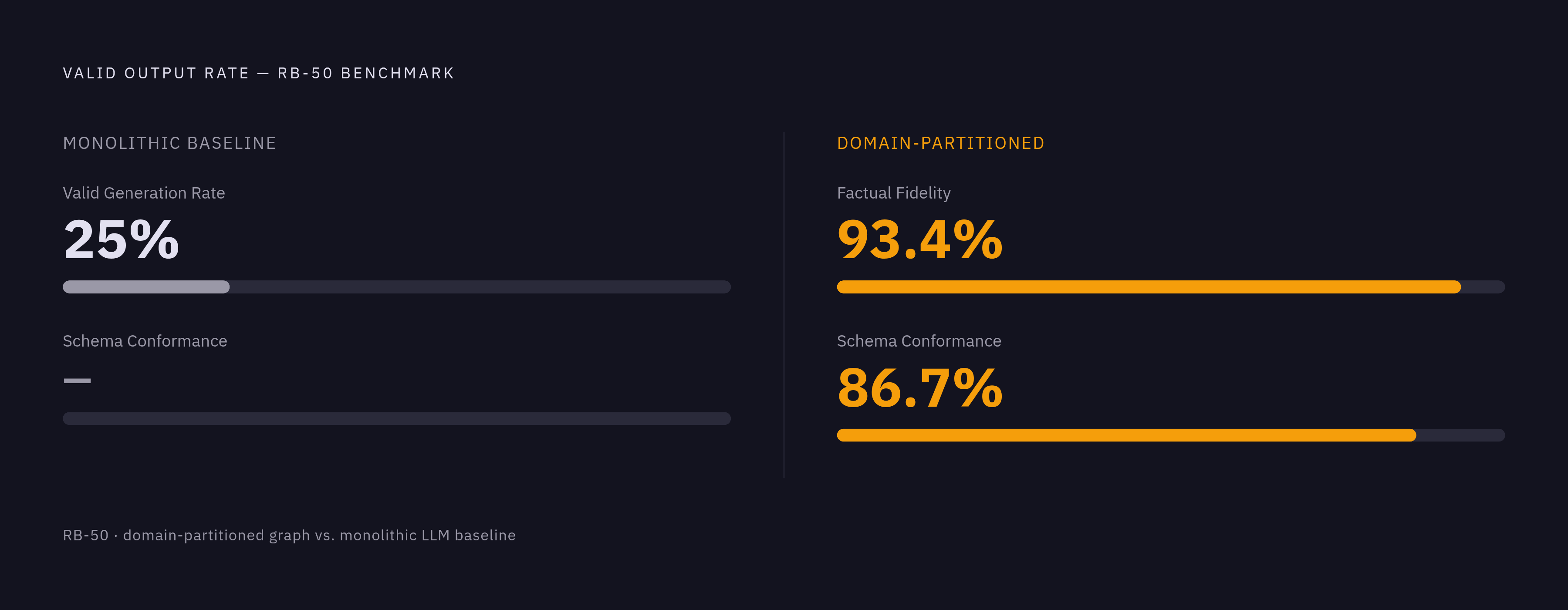
The performance cost is measurable. In the RB-50 benchmark, a single combined graph achieved a valid output rate of roughly one in four. A domain-partitioned approach in the same study reached a Factual Fidelity score of 0.934 and a Schema Conformance rate of 86.7 percent. That gap cannot be closed by tuning. A single combined graph can only hold multiple valid definitions of the same entity if something in the structure says which definition applies where.
What domain partitioning means in plain terms
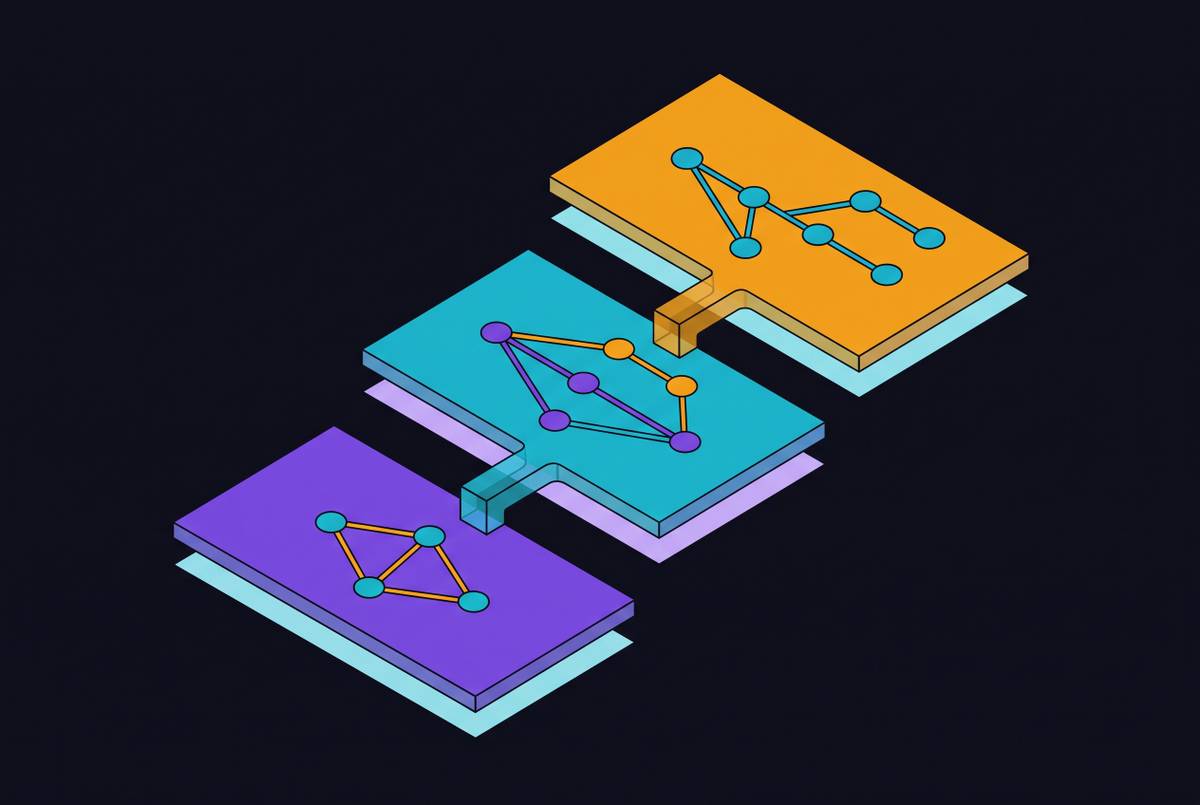
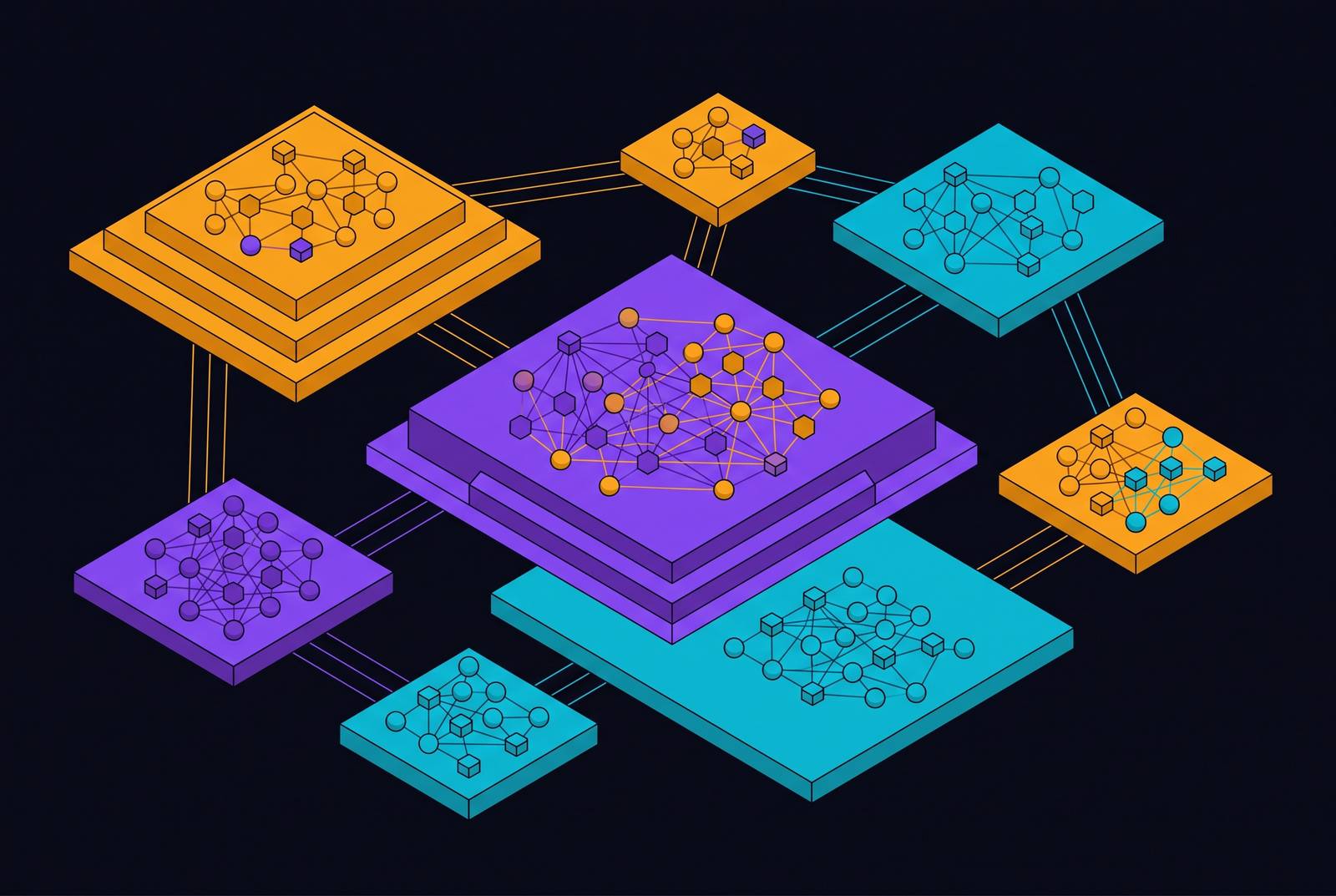
Domain partitioning means breaking a knowledge graph into separate sections, one per business area. Each section has its own rules and definitions. Connections to other sections happen only through explicit, governed hand-off points. The concept comes from a software design practice called Domain-Driven Design. The Knowledge Proliferation Engine paper calls these sections "domain-specific scopes." They reduce conflicting definitions when an AI model generates knowledge.
Think of one person inside a company. Their job application lives in a recruiting system. Their licensing progress lives in a compliance system. Their support history lives in a customer service system. A partitioned graph gives each area its own rules where local definitions live untouched. Above that sits a shared coordination layer. The Knowledge Proliferation Engine (KPE) framework calls this a "pure Shared Kernel." It holds only the minimum facts needed to connect entities across sections.
It is also worth saying what partitioning is not. Galaxy's 2026 platform analysis tells apart a complete knowledge graph from storage or catalog tools that cover only some of its layers. A complete graph includes the rules for how things relate (called an ontology), mappings from source systems, entity matching, tracking of data origins, access controls, and query access. The ontology lives in open standards such as RDF, OWL, and SHACL — these are vendor-neutral formats anyone can read — so the model stays portable. Proprietary formats lock you in. They are not a partitioning strategy.
One honest limitation: domain-specific knowledge graphs are never complete because their data sources are restricted and upkeep is costly. The ExeFuse research addresses this by pulling in relevant facts from broader general knowledge sources.
How one real-world entity stays coherent across sections
Splitting the graph is the easy part. The hard part is keeping one real-world entity — a person, a company, a product — coherent when different sections describe it differently. The Federated Identity-Role Model is the structural answer. The KPE framework builds it from two parts: a Shared Kernel and Domain Proxies. The Shared Kernel holds the minimum shared identity record. Domain Proxies are local versions of that identity in each section. They carry only the attributes that section needs.
The Shared Kernel holds just enough: a stable identifier and the relationships that cross section boundaries. Domain Proxies extend it locally. Section-specific details do not pollute the shared layer. This matters in practice. An insured party, a broker, and a claimant can be the same legal entity described under three different sets of rules. Without clear identity alignment, a query asking for total exposure across all lines either produces a fragile join across systems using different keys, or no answer at all.
The evidence for this alignment approach is early but directional. In a focused case study, the KPE framework correctly resolved 13 of 15 expert-checked queries that required reasoning across section boundaries. The alternative — one shared set of rules that every section writes to — brings back the same conflict problem through a different door. The Shared Kernel holds only what belongs in cross-section scope, and nothing more.
Making domain graphs richer without widening their scope
Domain-specific graphs are narrower than general knowledge graphs by design. The answer is not to widen the scope and bring back conflicts. It is to draw in relevant facts from general knowledge sources in a careful way. The ExeFuse research identifies a key challenge: general knowledge graphs are abstract and broad, while domain graphs need fine-grained, context-specific detail.
ExeFuse addresses this through a "Fact-as-Program" approach. It sets the right level of detail by telling apart facts that merely look like domain content from facts that are logically relevant to it. The graph gets richer without losing focus.
Why AI-powered search over your graph needs domain partitioning to give real answers
GraphRAG — a technique that combines graph traversal with AI-generated answers — depends directly on whether your graph has a coherent domain structure. Standard AI search retrieves text chunks that are similar to a query. It cannot follow relationships or reason across connected entities. A question like "what is our total exposure to this insured across all lines" requires following a chain of connections, not finding similar text. These two approaches answer structurally different types of questions.
With a partitioned graph and matched entities, that query hits one connected model. Without partitioning and entity alignment, GraphRAG moves through a fragmented structure. It produces the same unreliable results as manual integration: partial, conflicting, and untrustworthy. A coherent graph can support reliable answers — but only if the entity threads are aligned across boundaries.
Traceability is also graph-structural. In regulated industries, "these text chunks were similar to your query" is not an acceptable audit answer. A knowledge graph provides a traceable path: Entity A linked to Entity B via Relationship C. A compliance officer can inspect it. That path only exists if entities are coherently matched across section boundaries.
How section boundaries become permission boundaries for AI agents
Section boundaries in the graph are also permission boundaries. Their absence is the structural root of most enterprise AI agent security failures. Agent use has roughly doubled since December 2025. The number of unmonitored agents is growing even as stated confidence in visibility rises.
Session-level access control is not enough for agents. Domain partitioning is the structural mechanism that makes separation enforceable. An agent in the Claims section can read shared identity data from the Shared Kernel but cannot write in the Policy section.
The same report identifies orphan risk — agents or processes with no clear owner — as a direct result of missing section accountability. Section-scoped permission structures can surface and bound that risk. Approvals, quality standards, risk limits, and exception ownership can attach at the section boundary. Recurring work then runs within current permissions without needing case-by-case sign-off.
Why regulators now require traceable decisions across section boundaries
Regulators now require that AI-assisted decisions touching multiple sections can be reconstructed with their evidence path intact. A single combined or siloed graph cannot satisfy this. A partitioned graph with explicit cross-section alignment can. Since 5 February 2026, the UK's Data (Use and Access) Act 2025 has required safeguards for significant automated decisions. This includes the right to contest them and get human intervention. That applies directly to AI agents acting on knowledge graph outputs.
The EU AI Act adds more weight. Its main obligations for standalone high-risk systems were deferred to 2 December 2027, pushed back from the original 2 August 2026 date by the Digital Omnibus on AI, which entered into force on 27 July 2026. The deferral increases the importance of documentation and traceability for AI systems used in regulated workflows. A governed, domain-partitioned graph — combined with contemporaneous decision logs and versioned data — can rebuild the evidence path. It shows the authority under which the decision fell, the definitions and relationships used, the inputs available at the time, and the sources from which they came.
A decision record captures all of this. It is a connected record of evidence, recommendations, human reasoning, approvals, actions, and measured outcomes — including failed or inconclusive results — that spans the section boundaries the decision crossed. People must be able to add corrections and explain exceptions. Without it, early findings become permanent facts in the graph.
Building the partitioned graph step by step: sequence, ownership, and the trap to avoid
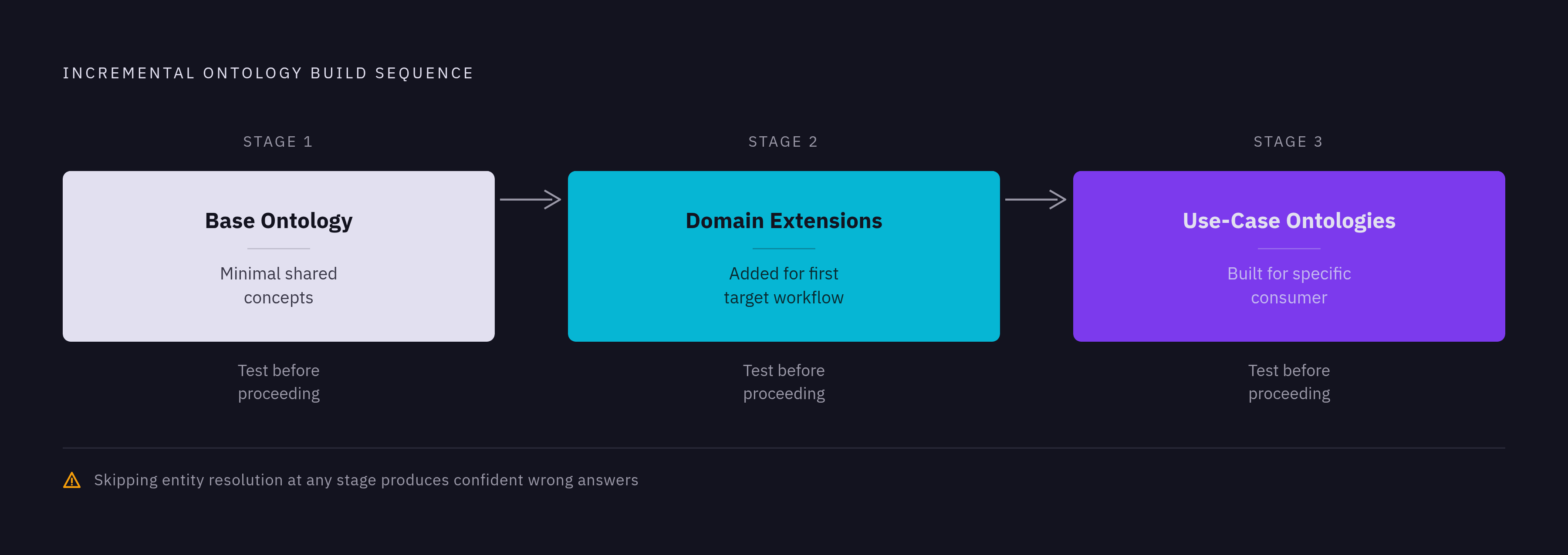
Teams that reach production value fastest start with one named section and one real workflow. Trying to define all sections, all relationships, and all entity types before anything is live produces months of modelling work with no measurable outcome. The model is usually wrong by the time the first workflow tests it.
The sequence that works is: base rules first, then section extensions, then use-case rules. Set up a base ontology covering the minimum shared concepts. Add section extensions for the first target workflow. Then build use-case rules that satisfy the specific consumer. Each layer is testable before you build the next. Teams that skip or compress entity matching produce confident wrong answers.
Settle ownership before modelling begins. Start with read access and investigate before you ask for write permissions. If you show that recommendations are sound in one section before you allow cross-section action, you govern better and earn stakeholder trust faster.
Evaluating deployment: data residency, model flexibility, and what ownership actually means
The partitioned graph is institutional memory. Its value depends on whether your company controls the ontology, the entity matching rules, and the decision history — not on which model or vendor reads it. Galaxy's 2026 analysis frames ownership as four concrete properties. The ontology lives in open standards such as RDF, OWL, and SHACL, or in the company's own repository. The data stays in the company's own storage, not a vendor's system. Entity matching rules and their outputs are inspectable and changeable. Agents and applications reach the graph through interfaces the company runs.
Data sovereignty is a legal concept before it is a technology one. The prior question is who has legal authority over the data. Model flexibility follows directly from owning the graph. If the context graph, business rules, decision history, and permitted actions are stored in structures you control, a new model or agent can use them without rebuilding that knowledge. You can then compare each replacement against output quality, speed, risk, and total AI-plus-human cost.
The cheapest model is not always the least expensive overall. With strong coordination, simple work goes to faster, cheaper models and complex work goes to models with adequate reasoning depth. Flexibility around open model weights, data residency, and encryption is increasingly a vendor-selection criterion in enterprise buying decisions, not a feature of advanced deployments.
Measuring whether the partitioned graph is actually doing useful work
A domain-partitioned knowledge graph that is not measured against an agreed baseline and a named business outcome is a well-built infrastructure project, not a business asset. Agree the baseline, success measures, measurement owner, and time period before deployment, not afterward. Apply this to each section workflow independently so failures in one section do not distort the measurement of another.
Compare the full cost of action against the cost of delay and the cost of failure. For a partitioned graph, this includes implementation, integration, AI usage, human review, correction, change management, and monitoring costs — not just the cost of running the AI. Assess plausible failures by their likelihood, cost, detectability, and reversibility. A section boundary that makes a failure detectable and contained is more valuable than one that prevents a narrow class of errors but makes others harder to diagnose.
Adoption counts such as agent count, query volume, and user count are measures of use, not value. The relevant question is whether the section workflow produced better, faster, or lower-cost decisions than the pre-graph baseline. The graph's own decision records are the audit mechanism that enforces this distinction.