Human-in-the-Loop Validation for High-Stakes Graph Assertions
Human reviewers must validate each step of AI's chained reasoning before a final conclusion.
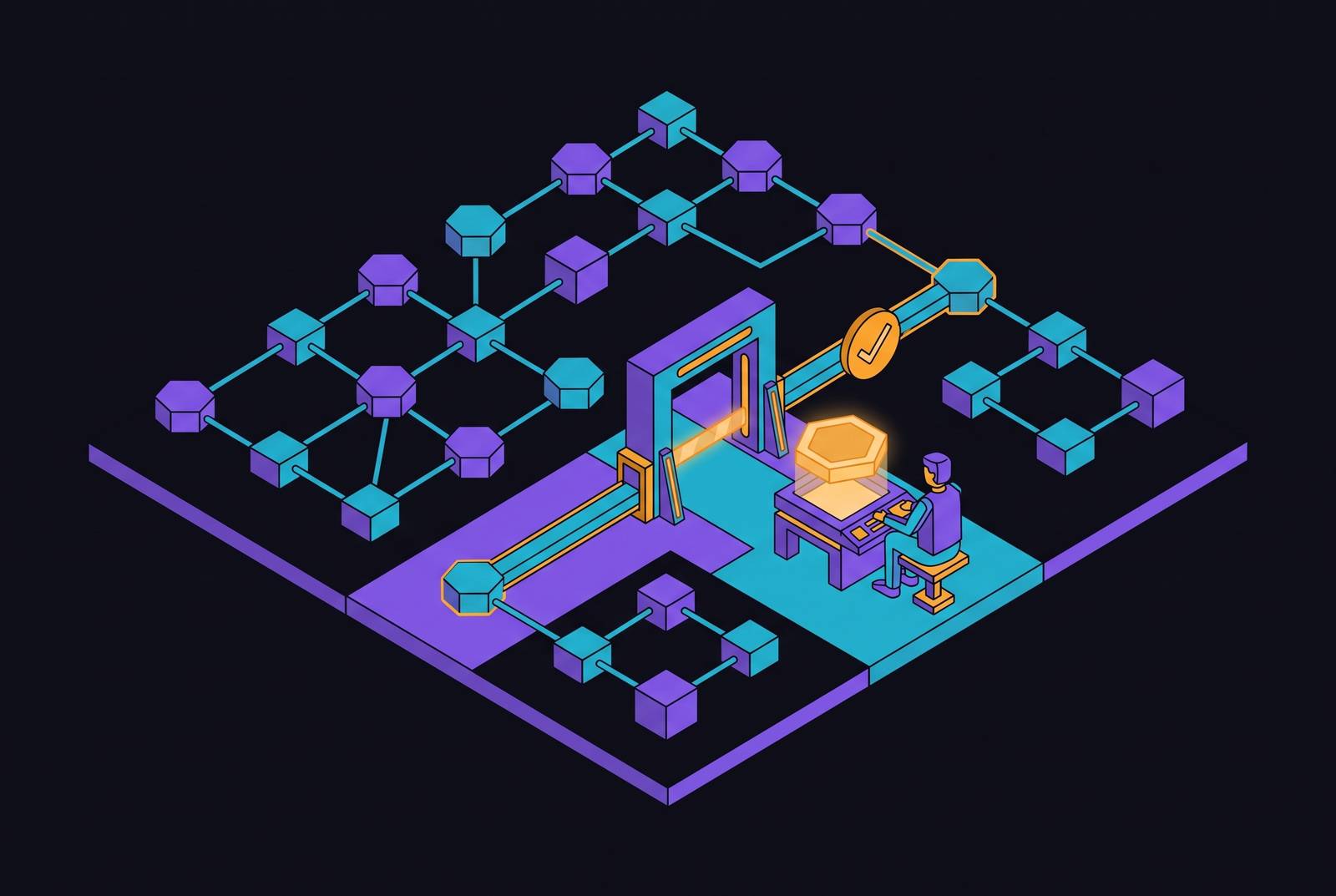
When an AI system chains several facts together to reach a conclusion, it can be confidently wrong in ways that are hard to spot. This article explains how to design a review process. It shows when a human should check conclusions, what information they need, and how to give them the real ability to act.
Why chained facts create a different kind of mistake
A claim like "Person A is licensed for Product B at Location C" is built from several connected steps. If any one step is wrong, the final conclusion is wrong too. But it still reads as a single, confident sentence. A simple one-step prediction gives you one thing to check. A chained conclusion gives you a chain. A chain is only as strong as its weakest link.
The numbers make the point clearly. Even if each step carries high confidence, several steps together can still be unreliable. Lukas, in March 2026, shows that in domains where rules shift often, high-capacity models find the loudest patterns. Those patterns are often false signals. Chaining steps makes that noise worse.
Chained conclusions also pull from many different data systems. Each connection lives somewhere else. Each could be out of date. The final sentence looks authoritative. But nobody can see the three systems that produced it.
Show that sentence to someone asked to approve it, and they see only the sentence. The messy joins, the questionable matches, the old records — all of that is hidden inside one confident claim. That is the core problem this article addresses.
Why missing reasoning records turn a wrong conclusion into an invisible one
Most enterprise systems record what was decided. They rarely record why. A bad conclusion can be acted on, repeated, and treated as fact. Nobody can trace where it came from. The error is not just present — it is invisible to the organisation's own memory.
A proper record must do more than log a timestamp and an approval. Without a full reasoning record, you cannot support an audit, fix the root cause, or review an exception. The record is not a compliance form. It is the only way the organisation can look back at its own reasoning later.
Without that record, the feedback loop breaks. The organisation cannot tell whether the problem was bad data, bad logic, or a changed rule. It keeps fixing symptoms.
One baseline condition follows from this. Separate the right to read from the right to change records from the start. A reviewer who can see the conclusion and the evidence behind it, but cannot quietly edit the source data, is the minimum for meaningful oversight. If the reviewer can silently change the source data, the reasoning record collapses into a decision log with no independent evidence.
Showing a conclusion to a human reviewer is not the same as designing for human judgment
The standard approach places the human after the AI output. Research shows that humans shown an AI output cannot reliably tell correct advice from incorrect advice. Over time their independent reasoning weakens.
The cause is the order. The reviewer has to judge good advice from bad. That is hard even in calm conditions. It gets harder under time pressure. It also gets harder when the AI is known to be right most of the time. The more often the model is right on average, the harder it is to spot the cases where it is wrong.
The loss of skill makes the problem worse. The review layer becomes less capable as the AI system becomes more embedded. The check that was supposed to protect the organisation gets weaker the longer it runs.
For chained conclusions the problem is sharper still. A reviewer may see a conclusion that came from a dozen connected steps. None of those steps are visible. Approving or rejecting that conclusion without seeing the steps is not validation. It is rubber-stamping wearing the clothes of review.
What a hybrid confirmation tree reveals about how to structure review
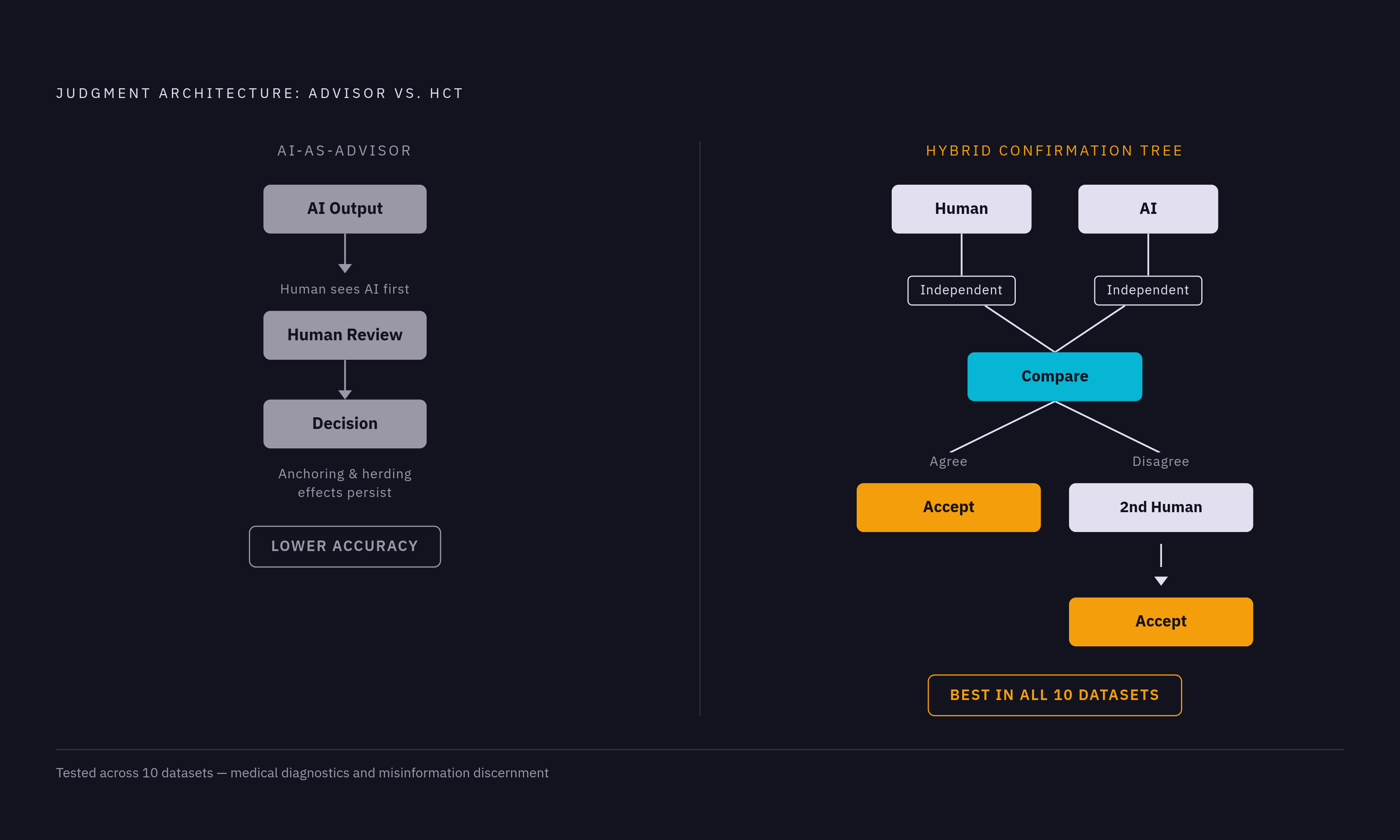
There is a structurally different way to arrange the work. Researchers compared the AI-as-advisor setup with a hybrid confirmation tree (HCT) — a method where human and AI judgments are formed separately and then compared. In the HCT, neither the human nor the AI sees the other's answer first. If they agree, the decision is accepted. If they disagree, a second human breaks the tie. Across ten datasets from domains including medical diagnostics and misinformation, the HCT outperformed the AI-as-advisor approach in every case.
What this shows is the value of independence. The HCT captures the benefit of combining two judgments. It also avoids the herding and early agreement that happen when the human sees the AI's conclusion first. The human is not reviewing the model. The human is making a separate judgment. The two are compared afterwards.
The tiebreaker role matters. The structure uses the disagreement signal in a useful way. It does not simply default to one side.
Applied to chained conclusions, the design is direct. The reviewer gets the relevant records and the claim to be tested. They form a judgment before seeing the system's confidence score or its conclusion. The comparison happens at the decision stage, not the output stage. The order matters. Showing the conclusion before the evidence actively harms review quality.
When more powerful AI models make chained conclusions less reliable, not more
In environments where policies, relationships, and rules shift often, the most capable model is not always the most trustworthy. Lukas, writing in March 2026, introduces Epistemic Compression and the Regime Index to explain why. In domains where rules change and data is poor, excess model capacity makes noise louder rather than signal clearer. The loudest patterns in the data are often false links.
The COVID-19 diagnostic AI case makes the danger concrete. High-capacity models learned shortcut patterns: hospital tags, positioning markers, features that had nothing to do with pathology. The model found the noise and called it signal.
The same thing happens with chained conclusions. The model's confidence does not fall as the underlying facts age. A pattern that was once valid becomes unreliable. Nothing in the model flags the change.
Human reviewers bring what the model cannot supply itself. They know whether the relevant rules have shifted: a new state regulation, a carrier policy change, a reorganisation. None of those events is in the training data. Each makes a previously valid chain of reasoning unreliable. A simpler, more cautious model that says it is uncertain on shifting-rule claims gives you a better signal than a more powerful model that has turned noise into certainty.
Confidence thresholds and escalation triggers must be set for each type of claim, not for a whole domain
Confidence thresholds — the point at which a claim is flagged for human review — must be set for each individual claim type and its consequences if wrong. How well a score is calibrated and how well it separates right from wrong are independent properties. A threshold that works for one class of claims says nothing about another.
The design tension is unavoidable. Set the threshold too high and humans review everything, which defeats the case for automation. Calibration has to be tested against your own production data and your own claim types.
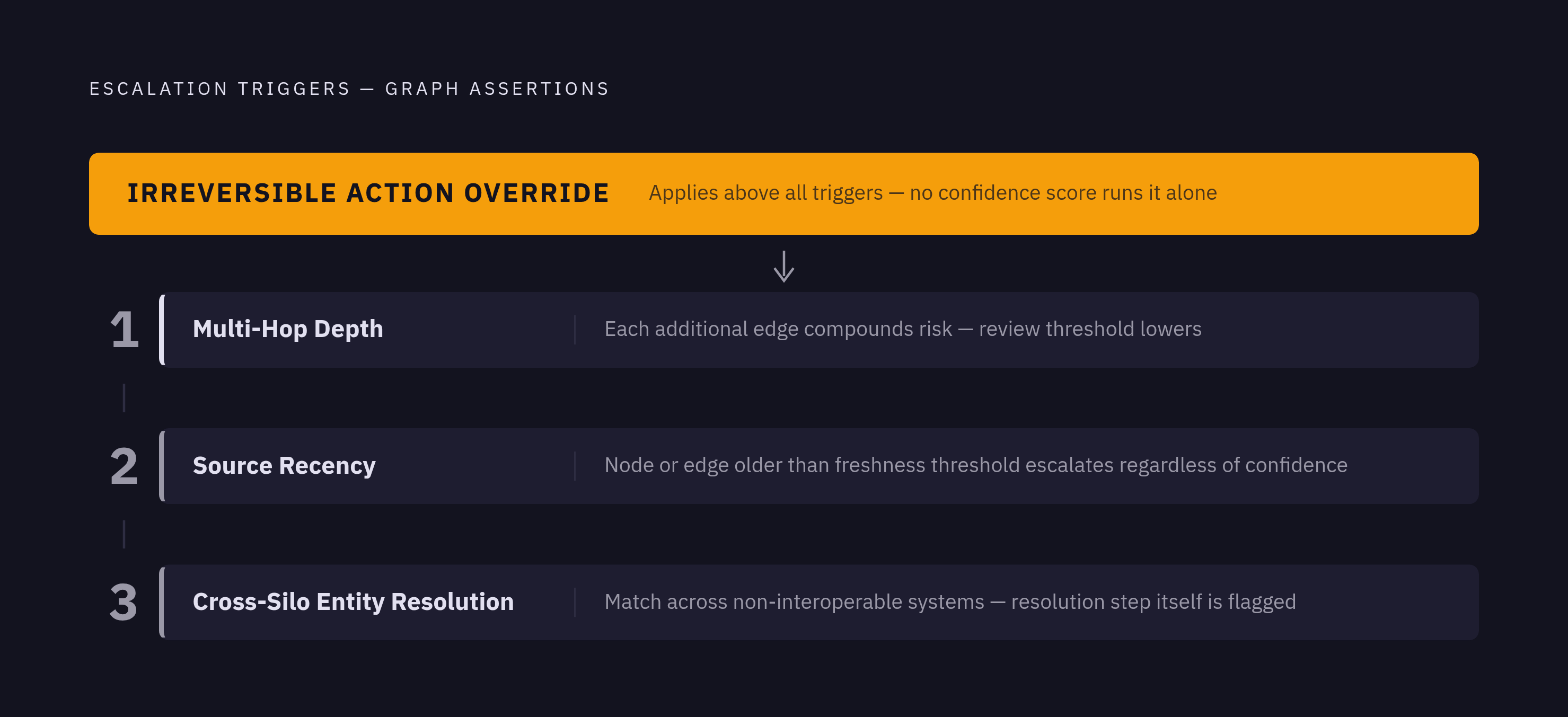
Three graph-specific escalation triggers matter in practice. First, chain length: claims that connect more than a defined number of steps carry higher compounding risk. They should trigger review at a lower confidence threshold. Second, age of source records: if any record in the chain is older than a defined freshness threshold, escalate regardless of model confidence. Third, matching across systems: when the claim requires finding the same real-world entity across two or more systems that were not designed to work together, flag that matching step itself for human check.
If a claim authorises an action that cannot be undone, that is the strongest single escalation criterion. No confidence score should run it alone. Over time, the volume of escalated items should shrink as the model learns where its steps go wrong.
What the reviewer needs to see, and in what order, for review to mean something
A review layer that shows the conclusion before the evidence is not a governance control. It is a rubber-stamp ceremony with the appearance of oversight. The reviewer must see the evidence first, before seeing the model's conclusion. That evidence package must include four things.
Each source record contributing to the chain, identified by which system it came from and when it was last updated. The steps that matched records across systems: which identifiers were matched, on what basis, and whether the match was exact or approximate. The action the claim will authorise if approved — not the claim in isolation, but its downstream consequence.
The HCT research shows why order matters. The reviewer should form a first judgment on the source evidence before seeing the model's conclusion. Showing the conclusion first causes anchoring — the reviewer's judgment is pulled toward the model's answer. That is exactly the failure that independent review is designed to prevent. Information order is a design decision with measurable accuracy consequences.
Read access and write permission are separate authorities. The reviewer must be able to inspect all evidence and mark exceptions without that inspection automatically counting as approval. Approval is a separate, logged action with a named person. Exception handling must be designed in, not patched on. When a reviewer overrides a conclusion, the override must capture the reason: the data was wrong, the logic was wrong, the policy had changed, or an edge case was not covered. Each requires a different fix. The decision record connects all of it: the evidence, the conclusion, the reviewer's reasoning, the approval or override, and the downstream action taken, including failed or inconclusive outcomes. Future conclusions on the same entity or path can then check whether conditions have changed before reusing a prior finding.
Who holds authority, who handles exceptions, and how the governance structure stays accountable
A review design without a named exception owner and real authority to pause or revoke a process is a procedure, not a governance control. The organisational structure has to match the technical design, or the technical design fails. Authority is the load-bearing wall.
Deciding whether a human must approve before an action runs, or whether a human monitors and can step in after, is a risk decision, not a philosophy. For chained conclusions that authorise actions that cannot be undone, explicit approval before the action takes effect is required. For recurring, lower-stakes conclusions with a proven track record, monitoring with exception escalation is appropriate. The move between the two should be explicit and logged.
Six controls make effective governance possible. An inventory of what conclusion processes are running. Limits on what downstream actions each conclusion can trigger. Human approval steps for high-consequence conclusions. Complete audit trails. Continuous monitoring with active pause and revoke capability.
The EU AI Act's Article 14 sets a floor. High-risk AI systems must be designed so that people can understand outputs and can step in, stop, or override. Organisations in insurance, finance, and healthcare should treat that as the minimum, not the design target. The floor is not the ceiling.
Agreeing on a baseline before deployment closes the loop. Keep estimates of expected value separate from observed results, and time saved separate from cash savings. That is the condition under which governance has something to govern.
How a well-designed review layer builds lasting value over time
A review layer that captures reasoning records, human corrections, and measured outcomes does more than catch errors. The cost of good review is paid once. The benefit keeps arriving.
This is the institutional memory argument. When the organisation keeps its reasoning history, its decision records, and its outcome history — including failed and inconclusive results — new models can be introduced without rebuilding that knowledge from scratch. The company's reasoning history travels with the company, not with the vendor.
Replaceability follows from there. If a new model can be tested against the same workload, the same claim types, and the same quality baselines that the prior model met, replacement decisions become evidence-based. The context and decision history are what make a new model immediately useful for company-specific work.
The compounding effect is measurable. Measure against it at the agreed interval. The review layer's value is the gap between those numbers over time, not a count of approvals processed.
An insurance hiring and licensing workflow shows the loop in operation. Candidates are checked against location-specific profiles. Licensing gaps are found. Each reviewer correction feeds back into the model's calibration. Every turn of that loop makes the next conclusion cheaper to review and harder to get wrong. That is the compounding asset.