OWL vs. RDF Schema for Enterprise Ontology Design
OWL adds reasoning power, but RDFS often suffices for enterprise data linking.
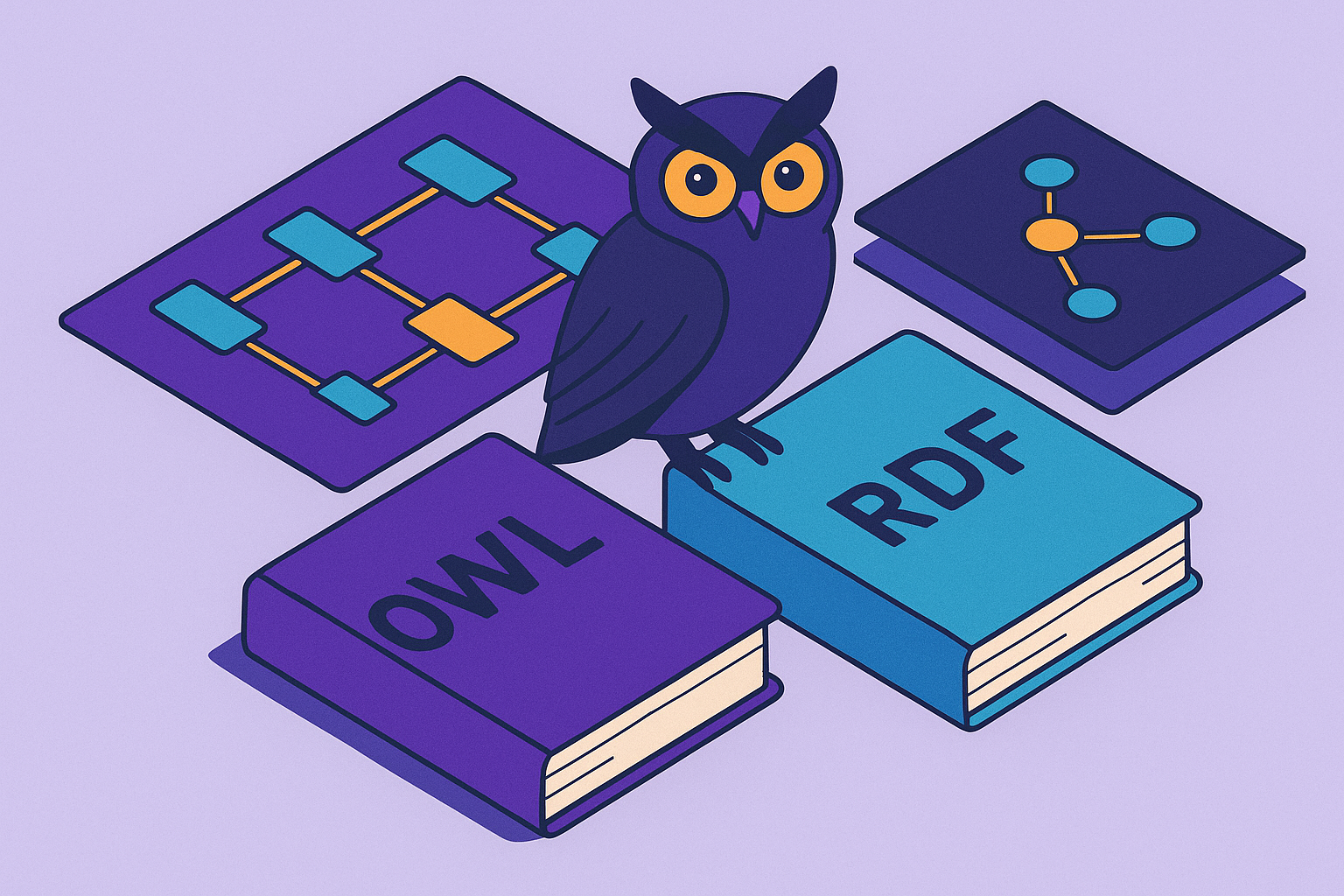
RDFS and OWL get discussed as if they were two competing products, the way you'd compare one database against another. They're sequential layers of the same W3C stack, and every OWL ontology is itself a valid RDF document. RDF gives systems a shared way to name things with URIs, connect them as a graph, and pull data together from many sources. The Atlan primer on RDF versus OWL puts it well: RDF "sits near the bottom of the Semantic Web stack, just above raw web identifiers and serialization formats." RDFS builds on that foundation with the first layer of schema: class hierarchies, taxonomic relationships, property hierarchies, domain and range rules. OWL builds on RDFS again, adding formal description-logic semantics on top, things like cardinality constraints, logical operators inside class definitions, and the reasoning machinery that lets a system infer new facts from old ones. Atlan calls OWL "the contract for a domain, it spells out what kinds of things exist, how they relate, and what must be true in a valid model." The stack only runs one way. OWL reasoning requires RDF triples underneath it, so RDFS is already present the moment OWL shows up. So asking "RDFS or OWL" is a bit like asking "foundation or roof." The real question sits somewhere else.
The single practical question that determines which layer you need
Does the business need machines to infer new facts and enforce domain logic, or does it only need to link and query data that already exists? That single question settles almost everything else.
If the goal is connecting independently modeled datasets through shared identifiers, tracking lineage and ownership, and supporting queries across systems, RDFS does the job on its own. Adding OWL reasoning on top of that adds cost and complexity with nothing to show for it. But if the goal includes checking whether class hierarchies are internally consistent, classifying individuals automatically, deriving relationships that were never written down explicitly, or enforcing constraints on properties, OWL's formal semantics and a reasoner running underneath are required to do any of that.
In clinical terminology systems, a fact like "EnterpriseCustomer is a subclass of Customer" has to be derivable by the machine itself, not hand-coded. In regulatory rule modeling, a rule like "PaymentRelease requires Approval of a particular role when amount crosses a threshold" has to be checkable automatically by an agent acting on the data. In product configuration, verifying whether a particular combination of features is even valid requires the system to reason about satisfiability, not just look it up. Atlan names four domains where OWL inference earns its place: clinical terminologies, product configuration, regulatory rule modeling, and master data management [1].
The common objection runs the other way: if OWL can do more, why not default to OWL everywhere? Richer semantics sound like a safer bet on paper. But expressiveness comes with a real tooling cost, reasoners, URI management, ontology editors, SPARQL endpoints, and that's a different toolchain than most data teams already operate. Enterprise systems that connect data across silos and delegate decisions to authorized agents, such as Nodes Engine, which builds a company-owned context graph to inform approved work, often begin with RDFS-level linking and shared identifiers, then add inference only when workflows genuinely require the system to derive new facts or enforce domain constraints on its own. Deploying OWL reasoning where it isn't needed adds operational overhead with no business return to show for it.
The open-world assumption as a structural caution for enterprise teams
OWL carries a philosophical commitment that most enterprise systems don't share, and that commitment shapes how a reasoner treats missing information, which is more consequential than any syntax detail. In OWL semantics, anything not stated is treated as unknown, not false, and a reasoner is free to derive it anyway from other axioms in the ontology. That's the open-world assumption, and it runs in the opposite direction from how enterprise analytics and workflow systems are built to behave. In an analytics or workflow context, something "not stated" effectively means it does not exist. A query that can't prove a fact should return nothing, not a guess dressed up as an inference.
A data warehouse holds a fixed set of tables. Enterprise analytics is closed-world by design, built on the premise that if a fact isn't in the data, it isn't true for the purposes of the report. That makes the inference-first, open-world model behind RDF and OWL a structurally awkward default for pure analytical workloads, no matter how philosophically rich the open-world model is on its own terms.
This has a direct practical consequence. For applications built around strict closed-world assumptions, compliance reporting, financial reconciliation, claims adjudication, plain RDF paired with application-layer logic can be the better structural fit, because its open-world inference model actively works against what a closed-world requirement demands. If your system runs on closed-world assumptions, map what it needs before you commit to OWL reasoning. Platforms that manage approved work and decision traces within defined authority and current permissions run in exactly that closed-world mode, where what isn't stated should not be inferred, and in that setting plain RDF with application logic often outperforms full OWL reasoning.
The lesson for ontology design teams is to map a workflow's world-assumption requirements before picking a layer, not after the ontology is already built and the mismatch starts causing strange results downstream.
Choosing the right OWL profile when inference is genuinely needed
Once a team has genuinely concluded that inference is required, the next mistake is treating OWL as one monolithic setting rather than a family of profiles with real trade-offs between how much they can express and how fast they can reason. Picking the wrong one produces either a system that grinds under its own reasoning load or one too weak to do the job it was built for.
OWL 2 QL is built for query rewriting over large relational databases. It's the right choice when the ontology sits on top of an existing SQL data store and the main workload is answering queries fast, not performing deep classification. OWL 2 RL is built for rule-based systems, and for most enterprise knowledge graph projects that aren't working at biomedical scale, it tends to hit a sweet spot of expressiveness and performance. Full OWL 2 DL offers the richest expressiveness of the three, full description-logic semantics, but reasoning time grows as the ontology grows. That cost is worth paying in domains like clinical terminology or regulatory logic, where the depth of inference justifies the computation it demands.
None of these choices are permanent. A team can start with RDFS or OWL 2 RL and migrate to something more expressive later as use cases demand it, because RDF's schema-flexible design lets an organization evolve its domain model over time without disturbing the underlying data. That flexibility matters because profile choice doesn't just affect performance, it affects how badly interoperability problems compound later. The ISWC 2026 ontology interoperability framework found that ontologies in the same domain frequently fail to share the same conceptualization in the first place: one team's "first name" is another team's "given name," class definitions overlap without anyone noticing, and conceptual models drift away from the data instances they're meant to describe. All three problems get worse as expressiveness increases, because a more expressive ontology has more places for two teams' assumptions to quietly diverge [1].
How ontology interoperability problems compound at industrial scale
When ontologies multiply across business units without a shared framework to keep them aligned, the overlapping and conflicting concepts inside them end up blocking the very integration they were supposed to enable. The ISWC 2026 ontology interoperability framework lays out three failure modes that can appear at any point in the ontology engineering life cycle. At the design phase, teams build ontologies that don't even share a conceptualization to begin with. During development, mapping cost balloons, because pairwise matching complexity grows with the product of the entity counts in each ontology pair you compare. At deployment, loading real data into the system exposes validation gaps as instance-level mismatches.
Ontology design patterns can reduce the first problem by giving teams hub-and-spoke abstract models to build from. But these patterns are static. They don't capture how a domain changes over time, and they can't enforce terminology either, since ontology creators remain free to name things however they like. Ontology matching and versioning addresses the second problem, but it's resource-intensive by nature: you have to repeat pairwise mapping for every new ontology pair, and it focuses on matching concepts to concepts rather than checking whether conceptual models line up with actual data instances. Ontology validation asks whether the ontology was built correctly in the first place, but at industrial scale, you hit a new bottleneck just finding enough domain experts to manually check proposed mappings.
The framework's recommendation is to apply all three techniques across the full life cycle rather than treating any one of them as a complete fix on its own: design patterns at design time, matching and versioning during development, validation before deployment. The knowledge graph triple example from ISWC 2026 shows why you can't skip an ontology backbone at scale. The triple (Sydney, travelsTo, Sydney) is meaningless without an ontology that defines Person and Place as constraints on what the subject and object are allowed to be. Without that backbone, a system has no way to know whether the first Sydney is a person and the second a city, or the reverse.
Why static ontologies drift
A well-chosen layer and a well-chosen profile still turn into a liability if the ontology gets treated as a one-time deliverable instead of something that has to keep up with a production data estate that changes faster than any quarterly review cycle can track.
An emerging alternative, often called an active ontology, keeps definitions tied to live signals coming out of the data estate itself: lineage events, governance changes, schema updates, usage patterns. Those signals trigger updates so the ontology's definitions describe what production actually looks like today, not what it looked like when the ontology was first designed. This is close to a requirement for using an ontology as a dependable foundation for AI agents, because an agent reasoning from stale concept definitions ends up inferring from the wrong model of the world.
The ISWC 2026 framework backs this up directly: ontology design patterns, the most common design-phase tool available, are static by nature and "tend not to capture changes over time." That's a structural limitation built into the tool, not an accident of how any one team happened to use it.
A natural objection follows: why not just re-run ontology matching whenever schemas change? Because pairwise matching complexity grows with entity count, ad-hoc re-matching gets more expensive every time the ontology grows, not less. If you bind definitions to live lineage events, that's the only approach on the table that scales without demanding proportionally more human effort every time something shifts.
Governance structure for an authoritative enterprise ontology
Even if you choose the right layer and the right profile, it will degrade in production if nobody owns the ontology clearly enough to keep it under control. Ownership usually lands with data governance, enterprise architecture, or a central data office, but technical custody isn't the same as semantic authority. Business domain owners need real decision rights too, because they're the ones who approve the meanings, rules, and exceptions the ontology encodes. Splitting custody from authority opens gaps fast.
The governance features that actually matter in practice are concrete: shared workspaces, review flows, draft states, publishing controls, rollback, change history, ownership records, provenance, audit trails, approval gates, stewardship tasks, policy alignment. None of these are optional extras for ontologies that touch reporting, compliance, AI outputs, or regulated decisions. Keeping an ontology consistent over time takes dedicated semantic stewards as an ongoing operational cost, not something budgeted once at launch, and the staffing commitment scales up with the number of entity types the ontology covers.
OWL's formal constraints make this kind of governance enforceable by machine, beyond what a policy document alone can enforce. If a property is constrained to exactly one Counterparty, and a rule states that PaymentRelease requires Approval from a specific role once an amount crosses a threshold, an agent's available actions become something the system can check directly against the ontology, rather than something a human has to verify by hand after the fact. That's the direct line between the RDFS-versus-OWL layer decision made early on and the workflow authority and exception ownership an organization ends up with later. Nodes Engine's approach to this problem keeps decision traces and outcomes tied to defined permissions, so approved work stays checkable against the same authority structure that governs the ontology itself.
From context graph to enterprise intelligence layer
Once an ontology sits on the right layer, carries the right profile, stays governed, and keeps up with changes in the data estate, it becomes the thing that lets AI agents operate on a company's actual meaning.
A context graph built on this foundation connects business meaning and relationships across the systems of record a company already runs. A single person's application, their licensing progress, and their support history might live in three separate systems, but the graph ties together what those records mean for the same workflow and the same person, which is what makes the company's existing data useful to AI in the context of the actual work being done. Atlan's analysis of modern metadata platforms notes that many now store asset relationships in graph-based metastores "inspired by ideas from RDF," so they can track how datasets, columns, and dashboards connect to one another through lineage and usage.
OWL adds something further on top: a principled way to scope what tools an agent is allowed to touch. Tools become verbs attached to specific types, and authorization becomes conditional on the state of an object and its relationships to everything around it. The ontology functions as the control plane for what an agent can do, not merely a schema describing what data looks like. Model-agnosticism only becomes possible once company context is held separately from any particular model, so that as models change, the context graph, the decision history, and the record of outcomes stay intact and keep informing the next decision regardless of which model is doing the reasoning.