Reification Patterns for Asserting Graph Metadata
Three RDF patterns handle metadata on knowledge graphs differently.
A knowledge graph that only stores bare facts cannot tell an agent whether those facts still hold, who put them there, or how much to trust them. An agent reasoning over such a graph has no way to know if a claim is current, who asserted it, how confident the source was, or whether two conflicting statements trace back to the same authority or two different ones. That gap matters most in three recurring situations: facts that are time-bounded, facts that depend on which source produced them, and facts that are flatly contested.
Time-bounded facts appear constantly in production systems: an infrastructure object is valid from one date to another, a policy has a version number tied to a window of enforcement. Contested facts occur when two systems report different values for the same thing, a different account balance, a different status flag, with no record of which one to believe.
The European Union Agency for Railways ran directly into this problem.
The consequence for AI systems built on top of these graphs is direct. An agent handed a graph with no provenance or temporal metadata cannot distinguish a stale fact from a current one. It cannot tell a high-confidence assertion from a guess, or a first-party record from a claim imported from somewhere else. Whatever errors or staleness already sit in the graph, that agent carries forward into every decision it makes, because nothing in the graph tells it otherwise.
Reification and the Three Patterns
Reification is the technique of treating a triple itself as a thing you can make further statements about. A basic RDF triple is just subject, predicate, object: Fred has four legs. Once that triple becomes a resource with its own identity, predicates like assertedBy, timestamp, confidence, and validFrom can attach to it directly, turning a bare fact into a fact with a paper trail.
Three patterns do this work in RDF today, and each one picks a different point in the data model to hang that paper trail on. Standard RDF reification uses the built-in rdf:Statement type, with explicit rdf:subject, rdf:predicate, and rdf:object properties rebuilding the original triple as a set of describable parts. Named graphs group triples under a graph IRI, a kind of named container, and attach metadata to the container. RDF-star quoted triples embed the original triple directly using << s p o >> syntax, so that bracketed expression can stand in as the subject or object of a new triple without being decomposed into parts.
These three did not arrive at once. RDF-star came later still, built specifically to address both the verbosity of standard reification and the semantic looseness that named graphs had introduced along the way, developed through a W3C Community Group whose final report landed in December 2021, now moving toward standardization as RDF 1.2 under a W3C Working Group chartered in August 2022.
No single pattern won outright because each one trades away something the others preserve. Standard reification trades compactness for explicitness. Named graphs trade per-triple precision for grouping efficiency. RDF-star trades broad tooling maturity for compactness and granularity together. Those trade-offs map onto real differences in how enterprises actually use graph metadata. The next three sections take each pattern on its own terms before comparing them directly.
Standard RDF reification: what it costs to be explicit
Standard reification describes an annotated triple by rebuilding it as a set of explicit parts. To annotate the triple:Fred:hasLegs 4 with who asserted it and when, a graph needs a new node,:claim1, typed as rdf:Statement, with rdf:subject:Fred, rdf:predicate:hasLegs, and rdf:object 4 attached to it, followed by the actual metadata::assertedBy:Mark and:timestamp "2025-01-15T10:30:00Z".
The rdf:Statement typing plus the three rdf:subject/predicate/object properties already add four triples on top of the original fact, and that's before a single metadata predicate gets attached. Multiplying that across hundreds of thousands of facts, each needing provenance, balloons the store size well beyond what the raw data would require on its own.
That multiplication is not just a storage concern. Every query that wants to retrieve an annotated fact, along with what was claimed about it, has to join across the extra triples rather than reading a single statement. When stores get larger and join patterns grow more complex, traversal gets slower, right at the scale where enterprise graphs tend to live.
There's a subtler gap underneath the verbosity. Standard reification records that someone made a claim. It does not formally assert that the claim is true. The RDF specification never defined a formal interpretation connecting the reified statement back to the truth conditions of the original triple, so a reasoner can see that:Mark asserted Fred has four legs without any guarantee that the graph treats "Fred has four legs" as something it actually believes.
None of this makes standard reification wrong to use. It also fits when the priority is compatibility with existing SPARQL 1.1 tooling and the dataset being annotated is small enough that the extra triples don't cost anything meaningful in performance. Where those conditions don't hold, the pattern most practitioners reach for instead is named graphs.
Named graphs: the pragmatic workaround and its semantic price
Named graphs reduce verbosity by moving the metadata up a level. Rather than annotating each triple individually, every triple sharing a provenance context gets grouped into one named graph, identified by its own IRI, and a single batch of metadata predicates, assertedBy, timestamp, confidence, gets attached to that graph IRI once.
The syntax makes the savings concrete. GRAPH:graph1 {:Fred:hasLegs 4.:Fred:species:Dog. } groups two facts under one container, and a single annotation,:graph1:assertedBy:Mark;:timestamp "...", covers both of them at once. That's efficient whenever a batch of triples shares one provenance context: a single timestamped data load, a named source document, a regulatory submission that applies to everything inside it.
That convenience came with semantics that were never nailed down, and the gap is not a minor technicality. The RDF 1.1 specification deliberately left named graph semantics undefined, because by the time the specification was written, implementations were already using named graphs for incompatible purposes. Some treat it as a quotation, a record of what was said that explicitly stops short of asserting it's true.
That ambiguity turns into a concrete risk the moment data moves between systems. Loading triples from multiple named graphs into a single default graph can produce flatly contradicting statements with no way to recover which graph said what. A named graph built as an organizational partition in one system gets picked up by another system that reads named graphs as contextual assertions, and the metadata attached to it gets interpreted in a way nobody who built the original graph intended.
None of this argues for abandoning named graphs. The pattern remains widely supported across triplestores and remains the efficient choice whenever metadata genuinely applies at the level of a group: a batch load, a source document, a governance boundary that covers many facts at once. Named graphs fit source-level and batch-level provenance well. They fit granular, triple-by-triple annotation poorly, which is precisely the gap the third pattern was built to close.
The practical fix for teams already using named graphs isn't a different pattern at all: document explicitly which semantic interpretation a given set of named graphs carries, contextual assertion, partition, or quotation, so a future consumer of that data doesn't have to guess.
RDF-star quoted triples: triple-level annotation
RDF-star closes the gap that standard reification and named graphs each leave open: it annotates a single triple directly, without decomposing it into four extra triples and without losing that precision by grouping it into a batch. RDF 1.2 triple terms let a triple be embedded as-is, using << s p o >> syntax, directly in the subject or object position of a new triple.
The syntax shows how much is saved. <<:Fred:hasLegs 4 >>:assertedBy:Mark;:timestamp "2025-01-15T10:30:00Z";:confidence 0.95. puts the entire annotation, assertion, timestamp, and confidence score, into three triples total, against the five or more that standard reification would need for the same information. Multiple annotations stack without duplicating the base fact: <<:Fred:hasLegs 4 >>:source:VeterinaryRecord;:validFrom "2023-01-01";:validTo "2024-12-31". adds a source and a validity window on top of the earlier annotation, quoting the original triple once. Nesting works too: << <<:Fred:hasLegs 4 >>:confidence 0.95 >>:assessedBy:QualityControlAgent. lets metadata describe other metadata, a confidence score that itself has an assessor, without any added verbosity overhead.
The European Agency for Railways evaluation backs this up directly: across three different triplestores, RDF-star methods produced the most compact and the most flexible representation for temporal metadata among the five approaches the study compared.
Compactness came with a caveat the same study was honest about. At the time of the evaluation, RDF-star methods were less reliable than the more established approaches, and RDF 1.2, the specification that formalizes quoted triples, was still at Candidate Recommendation status. Tooling support across different triplestores was inconsistent as a result, so a pattern that's compact on paper requires the database underneath to support it cleanly to be of use to a practitioner.
Production use is not out of reach. TopQuadrant's TopBraid EDG 9.2 release completed a move to RDF 1.2, quoted triples included, showing the pattern is reachable in a real deployment and not confined to research papers. But that's one vendor's confirmed status, not a guarantee about any given team's stack. Compact storage doesn't automatically give you simple queries; you have to work out the two together.
RDF-star is the right fit when facts need metadata at the level of the individual triple, when each assertion carries its own confidence score, its own validity window, its own source, and grouping those facts into named graphs would either lose that granularity or force an unmanageable number of tiny graphs into existence. It's the right fit once the triplestore and SPARQL processor in use have confirmed, stable support for it. And when both storage compactness and query simplicity matter at once, it's the right fit, for agent-facing layers that need to walk a chain of provenance at query time without paying a verbosity tax for every link in that chain.
How the Three Patterns Compare
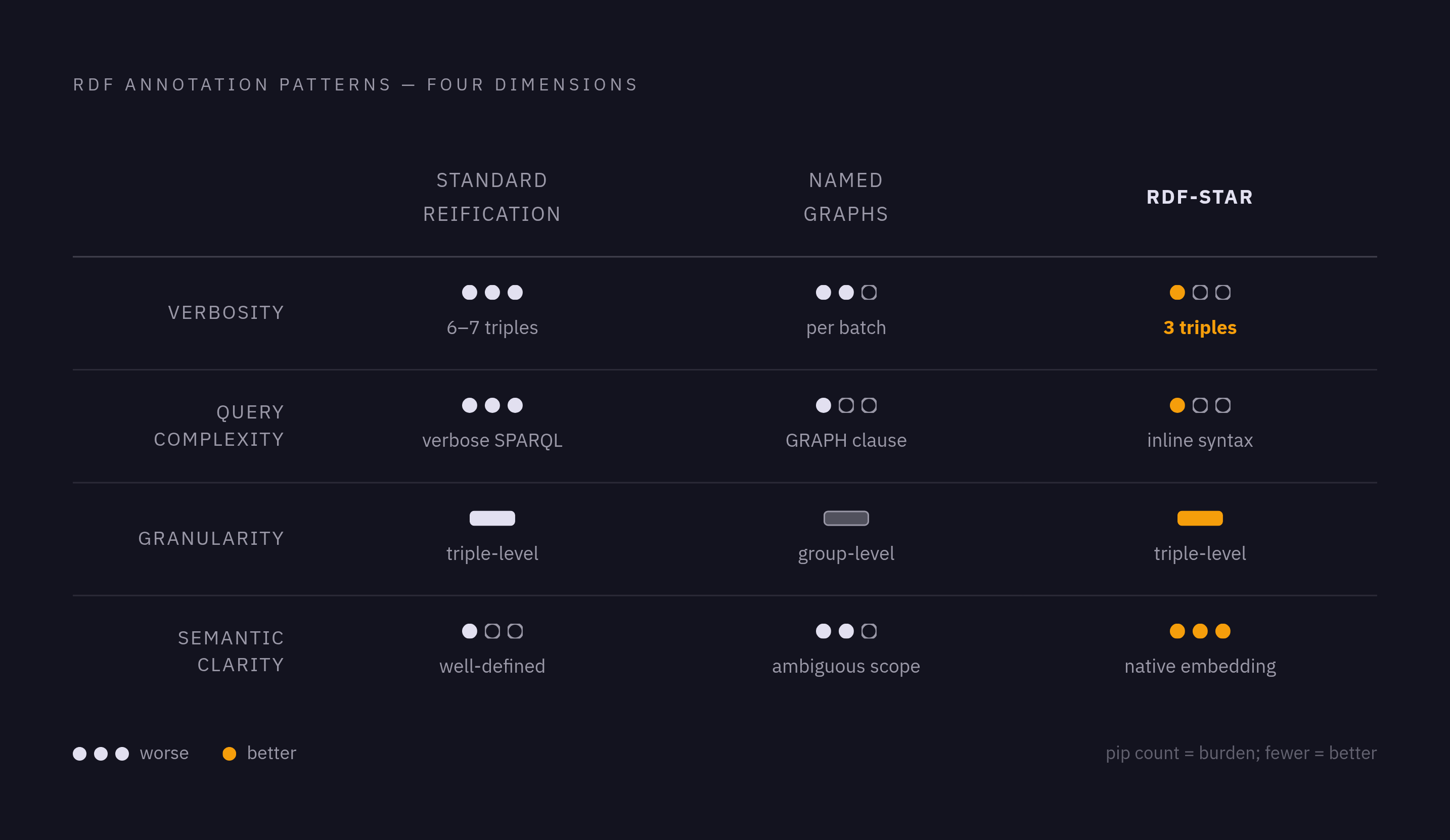
Four dimensions decide which of these three patterns fits a given job: verbosity, query complexity, granularity, and semantic clarity. Each pattern lands in a different place on all four, and the differences are consistent enough to use as a direct decision guide.
Verbosity runs from worst to best in a clear order. Standard reification is the most verbose of the three: every annotated triple generates an rdf:Statement node plus three structural properties before a single metadata predicate gets added, typically landing at six or seven triples per fact once provenance and a timestamp are included. Named graphs cut that cost sharply for any batch of facts that share one context, because the metadata attaches once to the graph IRI rather than once per triple. RDF-star cuts it further still at the level of the individual fact, fitting a full annotation, assertion, timestamp, confidence, into three triples.
Query complexity follows a similar order. Standard reification forces every retrieval to join across the rdf:Statement scaffolding to reconstruct what was claimed and what was said about it. Named graphs simplify retrieval for anything that queries at the batch level, since a GRAPH pattern in SPARQL pulls the whole group at once, but they complicate any query that needs to isolate metadata for one triple inside a larger graph. RDF-star, paired with SPARQL-star, lets a query target one quoted triple directly, but you still have to write the query patterns with that target in mind.
Granularity separates the three cleanly. Standard reification and RDF-star both operate at the level of a single triple. Named graphs operate at the level of a group. That single distinction decides a lot of real deployments on its own: provenance that genuinely belongs to a batch (a source document, a pipeline run, a regulatory filing) fits a named graph well, while provenance that varies fact-by-fact (one record vetted by a veterinarian, one by a sensor, each with its own confidence score) needs the triple-level precision that only standard reification or RDF-star can give it.
Semantic clarity is where the three patterns diverge most sharply from each other. RDF-star sits closer to standard reification in spirit, since a quoted triple keeps its structure intact and attaches metadata to that exact structure, though its semantics are still being finalized as part of RDF 1.2 moving through the W3C process.
Put together, the choice comes down to what a given enterprise graph actually needs to track. A small dataset on a triplestore with no support for newer patterns calls for standard reification. A large volume of facts sharing provenance in batches, a pipeline run, a source document, a filing, calls for named graphs, provided the team documents what interpretation those graphs carry. A graph where every fact needs its own confidence score, its own validity window, its own source, calls for RDF-star, provided the triplestore and SPARQL layer in use have confirmed support for it. None of the three is obsolete, and none is universal. Each one answers a different question about what an assertion needs to say about itself, and the right answer depends on which question the data is actually asking.
Sources
- Easy and complex: new perspectives for metadata modeling using RDF-star and Named Graphs
- Analysis of RDF reification approaches for the European Agency for Railways Knowledge Graph
- Don't like RDF reification?
- RDF Primer
- Foundations of an Alternative Approach to Reification in RDF
- Name That Graph
- Publications
- RDF-star Working Group Charter