How to Keep Enterprise Connectors Private and Verified at Scale
Build gateways that enforce policy before agents act, not after.
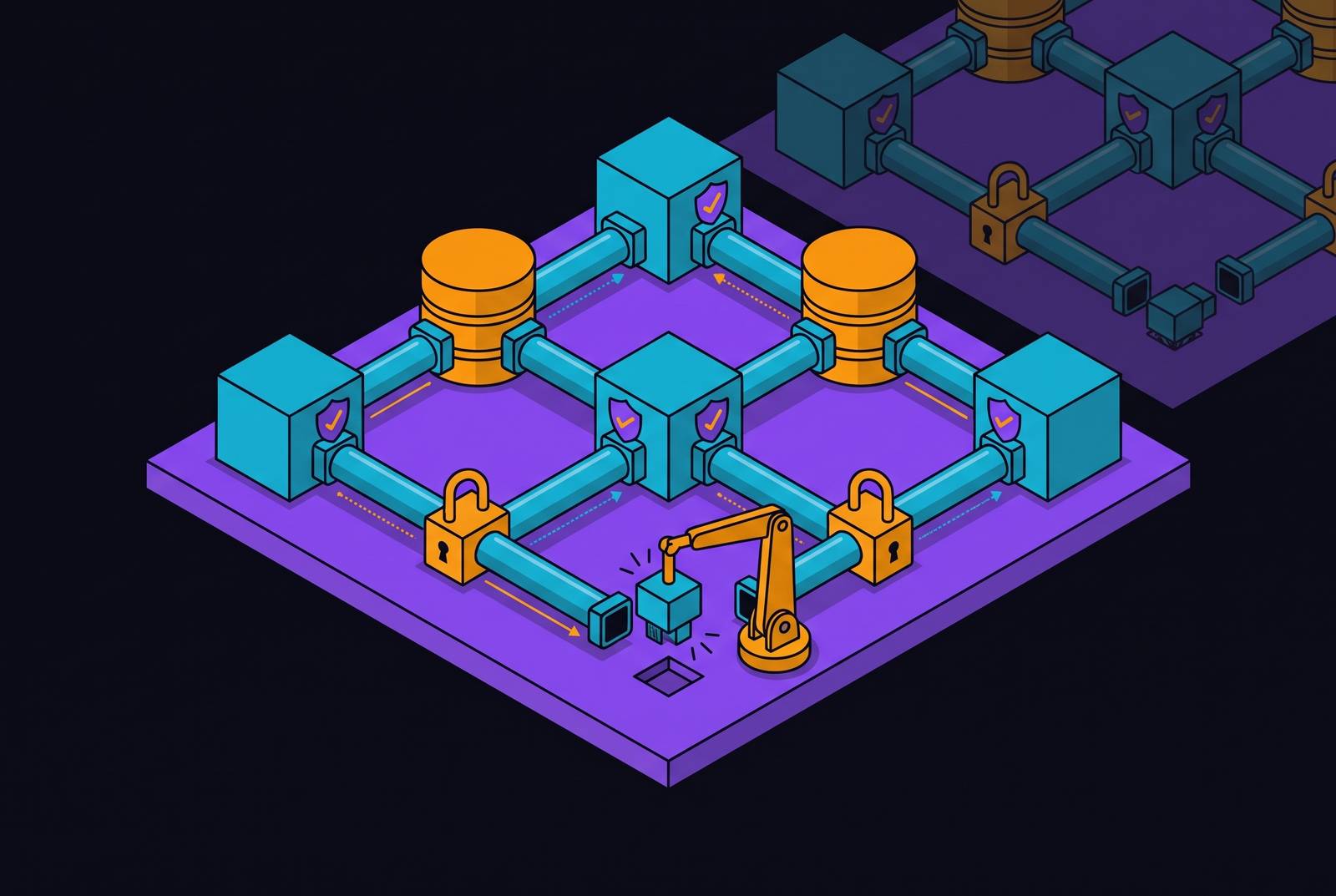
To keep enterprise connectors private and verified, you need three things. You need to control who can use each connection. You need to control what they can do with it. And you need a clear record of what they did. Approving a connector once is not enough. Permission to connect does not prove that every later action is correct or safe.
Why connector governance falls apart as you add more AI agents
A tool call is the moment an AI agent stops planning and starts acting. It might call an API, write to a database, or trigger a workflow. By the time you see the result, the action has already happened. That gap between watching and controlling is the core problem. NeuralTrust's 2026 enterprise guide names two central weaknesses: no risk check before execution, and no policy enforcement at the connector level.
The gap gets worse when different teams add integrations on their own. AGAT Software's 2026 analysis describes "shadow agents." These are agents that connect to servers and outside APIs that the security team has never mapped or approved. Each new connection gives an agent another way to act in your systems. But nobody may be clearly responsible for that path. More dashboards do not close those paths. Without limits tied to a specific purpose, adding integrations grows the unmonitored surface faster than governance can keep up.
What "private" actually means for a connector
A private connector controls which agent can call it. It controls what that agent is allowed to do. And it keeps a record of every call. Privacy is a design choice, not a checkbox. It has three requirements.
First, identity-bound access: each agent gets its own credentials instead of sharing one set of login details. That way you can always tell which agent did what. The agent's effective authority is whichever is smaller — its own permissions or the human user's permissions.
Second, limited scope. Microsoft's Cloud Adoption Framework for AI agents says read access and write access should be separate. Write permissions need a clear reason. Tokens — the keys that prove identity — should be short-lived and tied to a specific task.
Third, an audit trail at the tool-call layer. This is a record of what was called, which system it touched, and in what order. These three controls belong together. Identity tells you who acted. Scope limits what they could do. The audit trail lets you check how that authority was used.
How verified connections differ from approved connections
Approval records a governance decision made at one point in time. Verification checks that the connection still works under live conditions. It also checks that how the connection is being used still fits policy. Credentials can expire. Agent behavior can drift after approval. So a one-time approval is not permanent evidence of safe execution.
AGAT's analysis explains why valid credentials alone are not enough. Instructions hidden inside documents, emails, or API responses can trick an approved agent into misusing a legitimate access path. No break-in is required. That attack is called prompt injection. Verification therefore needs checks before execution. It also needs monitoring while the agent runs, and clear evidence after it finishes. NeuralTrust's guide recommends risk scoring before the tool call, when there is still time to stop a proposed action.
Treating all of this as a one-time approval keeps the most important checks outside the execution process entirely.
Using a gateway to enforce policy at scale
A gateway sits between agents and the tools they use. Instead of trusting each agent to stay within its own limits, the gateway intercepts every tool request. It checks enterprise policy, scores risk, and either allows or blocks the action. High-risk requests can be held in a queue for a person to approve. Routine, low-risk actions can be approved automatically within set limits. That keeps everyday work moving without granting unrestricted access.
That enforcement only works if you know which agents and connections exist. A central registry tracks agents, the people accountable for them, and the tools they may use. This includes connections created outside formal approval processes. Without that inventory, even a strong gateway policy only governs what is routed through it. Unknown connections stay outside the control model entirely.
Snowflake's Black Hat 2026 announcement describes Cortex AI Gateway incorporating Natoma as a centralized MCP (Model Context Protocol — a standard way for AI agents to call tools) gateway. It covers identity, policy, and audit at the tool-call level for both first-party and third-party agent systems through a single point. ServiceNow's Knowledge 2026 announcements in May included an expanded AI Control Tower and an Autonomous Security and Risk product. These govern agent identities, permissions, and the systems they connect to. The first focuses on enforcing policy at the tool call. The second extends governance to the agents and assets they reach.
Making approvals part of the workflow, not an afterthought
Approval becomes a catch-up task when execution happens separately from the person expected to authorize it. A review request that arrives outside the workflow can become a bottleneck. Or worse, it becomes documentation filled in after the change has already happened. The fix is to build an approval state directly into the workflow. Nothing can proceed without it.
The dividing line is consequence. Low-risk, repeatable updates can be automated. Changes that affect scope, release readiness, access rights, or customer commitments need an explicit approval step from a person. Read access must stay separate from permission to change records. That way an agent can investigate and recommend without also having the authority to act on its own recommendation.
For teams building this model, define what counts as approved before recurring work begins. Set the quality and risk limits. Set the budget. Decide who handles exceptions. Routine work can then run under the permissions and policies already in place. Exceptions still need a decision from an accountable person. The design is only complete when you can also pause or revoke an agent's authority — not just record that it exceeded its limits.
Keeping a clear record that approvals happened and outcomes were measured
An approval gate needs a durable record of what was authorized, why, and what happened next. A conventional activity log tells you what happened. A decision record goes further. It connects evidence, recommendations, human reasoning, approvals, actions, and measured outcomes — including failures and inconclusive results. That turns a sequence of events into evidence of a governed decision.
A structured decision record captures the goal, constraints, information retrieved, and policy chosen for each major step. Human corrections and explanations of exceptions belong in the same record. The agent's output alone cannot preserve the judgment that changed the decision. Otherwise the reasoning disappears while the action remains. That loss also feeds a skills problem: when people over-delegate, less visible evidence remains of how they assessed difficult cases.
Traceability also changes how an organization learns from automation. A measured outcome can guide later work, but teams need to check what has changed before reusing a lesson from the past. Past approval is not a standing instruction. When customers keep the context graph, decision history, and outcomes, that institutional memory can survive model changes. It is not locked inside a particular model or platform.
How connecting data across separate systems changes what an agent can verify
A permitted action can still be factually wrong. Verifying a connector checks access and operating conditions. But it does not reveal everything relevant to a business decision. A person's application, licensing progress, and support history may live in separate systems. Acting on one record alone can miss facts in another system that change what should happen.
A context graph links those records for the same person and workflow. Its job is not to grant broader permissions. Its job is to make authorized information usable together — structured records, documents, conversations, human judgment, and relevant outside developments. This lets verification go beyond checking credentials. The agent can ask both whether a system accepts the request and whether the action fits what is already known about the situation.
Insurance agent hiring is a concrete example. A working connection to a licensing database does not tell you whether a gap in a candidate's licensing history needs action or was already resolved in another system. Connected context makes that distinction available to the workflow. When the context and permission design are kept separate from the underlying AI model, replacing that model does not mean rebuilding the organization's knowledge and governance from scratch.
What running in your own infrastructure changes about connector governance
Cloud-based integration platforms (iPaaS — software that connects different business systems) connect systems and run integration workflows. But per-agent limits, live verification, and containment still need to be set up separately. Policies in a shared environment depend on the provider honoring them. A connection that works is not proof that the deployment boundary meets your governance requirements.
A VPC-native (Virtual Private Cloud — your own isolated section of a cloud provider's infrastructure) deployment keeps compute, storage, and AI workloads inside infrastructure you control. The provider can still deploy and manage the platform. But the environment stays within your cloud account. Operational access is then limited by the architecture itself. Running on your own premises has the same effect. Where you run the system becomes part of the connector-governance decision. So choosing hosting and deciding how to govern connectors go together.
For sensitive workloads, smaller open-weight models (AI models whose design is publicly shared) running inside your boundary can be a good fit. They keep processing within your data perimeter. They are not necessarily more capable models. Their value here is that they can be tested in place, versioned, and reproduced. A governance layer that is not tied to one specific model preserves context, decision records, and permissions when models change. Identity checks, approval gates, and pause controls remain necessary no matter where the platform runs.
How to add private, verified connector governance without rebuilding existing integrations
Start with one workflow, one accountable owner, and one measurable outcome. Microsoft's framework recommends defining which databases, repositories, and systems an agent may access. Enforce those boundaries technically. Document the baseline, success measures, and measurement period before deployment. Cost comparisons need the same discipline. Include the cost of acting, waiting, and failing — as well as AI usage, human review, correction, change management, and monitoring.
From there, the sequence is: discover, identify, scope, enforce, trace, and scale. Discovery means a continuous inventory of agents and their connections, including shadow agents and MCP servers. Identity comes before access, with agent credentials kept separate from human accounts. Scope then limits each agent to the permissions its task actually needs, rather than inheriting the full authority of an existing integration.
Enforcement must be in the execution path before you rely on behavioral monitoring to protect you. A gateway can impose policy over existing integrations without requiring every connection to be rebuilt. Decision records keep the evidence, approval, and outcome of steps that have consequences. Before agent counts grow, pause and revoke controls must already exist. Watching an agent is not the same as being able to stop it.
An AI forward-deployed engineer clarifies requirements, builds integrations, and configures and tests enterprise workflows. This means the execution system receives configured, tested connections. Nodes is one option that finds the value a company loses between its systems. Once a person approves, it fixes the problem — starting read-only, with nothing proceeding without a person's yes. It runs in the customer's own cloud, on the customer's own servers, or in Nodes Cloud. The customer keeps its data and what it learns even if it changes AI models. Its AI FDE helps with requirements, integration, configuration, and testing.
The first release should begin with investigation. It produces first findings that teams can compare against the agreed baseline, inspect for failures and exceptions, and use to decide where to add write authority as quality and value are demonstrated. Expansion follows evidence rather than connector count. That order preserves existing integration work. It also makes each increase in autonomy conditional on controls that already function.